
ERTMS implementation on the Gjøvik Line: A Project Manager's insights
The Gjøvik Line North is the first Norwegian line in operation using all-digital signaling. How does it feel to experience the new ERTMS system as a passenger? Join Hilde Marie Schade Flå, Project Manager for Siemens Mobility Norway, on her journey to Gjøvik and discover exclusive insights into the monumental project.
A transition that’s almost invisible
How it all started
Hilde Marie Schade Flå isn’t an ordinary passenger. The lively young woman has been a part of the ERTMS project for twelve years now.
“After graduating from university with Master’s in Technical Cybernetics and Real-Time Systems, I needed to decide what I wanted to do next. And I knew I didn’t want to work in the oil & gas or defense industry. I wanted to contribute to something big that has an impact on people’s lives,” Hilde Marie remembers.
She applied as a technical engineer at Jernbaneverket, now Bane NOR, to work on an all-new signaling system: the ERTMS project. She has seen it all come to life from project proposals, cost estimations and contracts. And then she went from customer to supplier: She has been working on the Siemens Mobility side of the project since 2020.

When I switched jobs and went over to Siemens Mobility as a project manager, I suddenly found myself having to fulfill the requirements that I have written while being on the customer’s side. So, I'm kind of facing myself now.
About the project
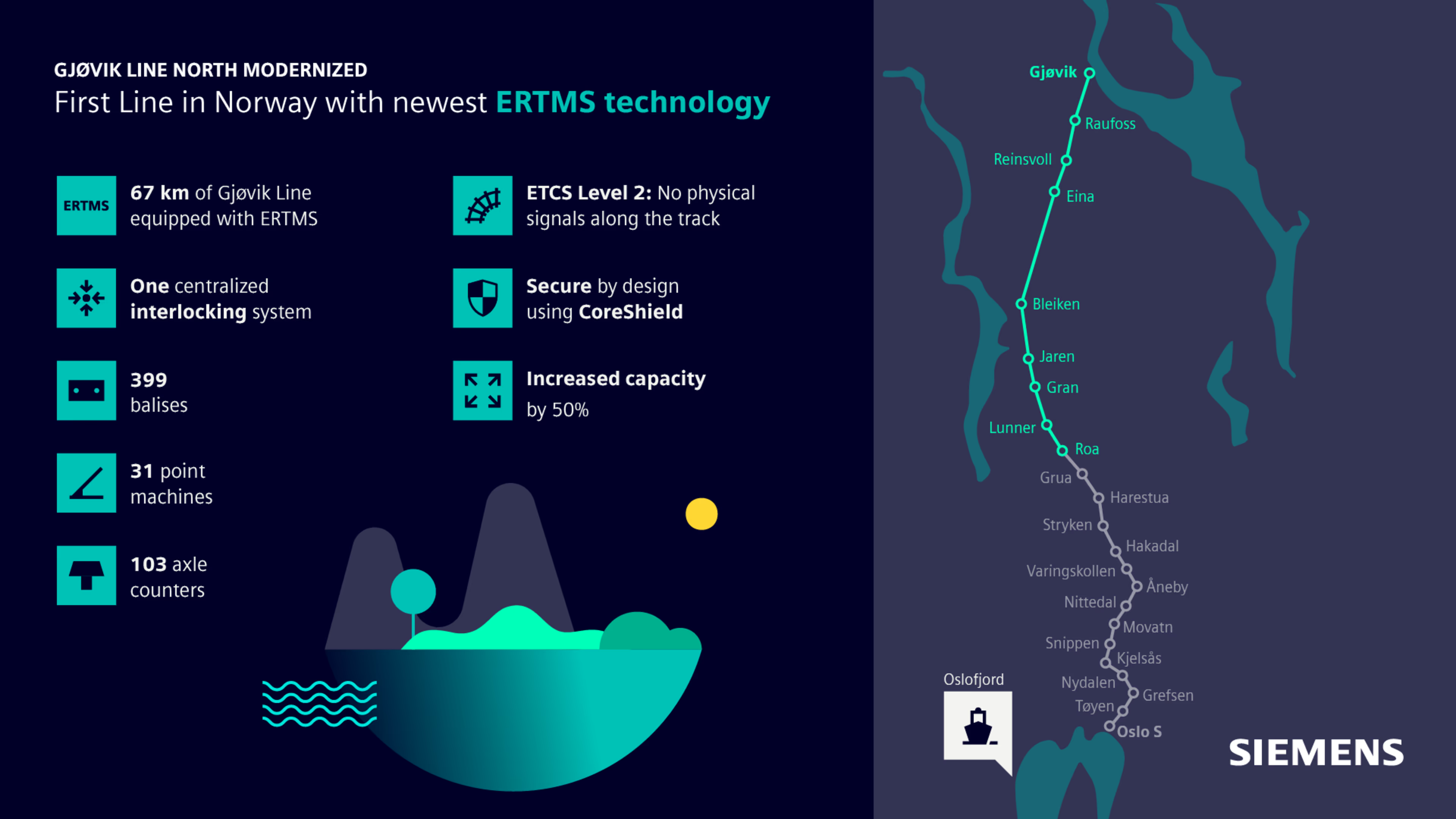
The Gjøvik Line North tells a compelling story of modernization: Prior to ERTMS deployment in November 2024, passengers faced a familiar scenario: trains running every other hour, weather-related delays, and operational challenges. Today, the same line is operated reliably on ETCS Level 2, offering hourly departures as well as improved operational stability and uptime compared to traditional signaling systems.
But it’s just the first step in the country-wide transition to ERTMS. When the transition is complete, all of Norway’s railway lines will have switched to ERTMS.
Siemens Mobility is deploying an extensive infrastructure network, exchanging all signaling components, modernizing stations and implementing a centralized interlocking system.
A challenging journey
Undertaking a complex project comes with challenges, not just in the implementation. The new equipment had to be tested thoroughly. Hilde Marie explains: “We performed a four seasons test. Everything was installed in different locations – some very warm, some very cold, some very windy and some close to the sea - around the country and tested for a whole year.”
Salt water and mist can affect the electronics in the equipment, as can the temperature, varying between -40°C and +40°C. The wind however turned out to be particularly challenging.
“It was very good that we had these tests to get all problems out of the way before the rollout!”, she says and laughs.
And it’s not just Siemens Mobility Norway that benefits from these tests, customers around the world do as well. The updated and improved equipment is now adapted to similar climate conditions across the globe.
Training as a key factor of success
With new equipment and the switch to a new technology also comes the need to train staff on the new system. For the complete implementation, more than 6000 employees need instructions on train operation and maintenance of the new system. A unique training center was created to train personnel train line by train line.
“For the Gjøvik Line North, 300 people underwent the training at Campus Nyland, Oslo”, Hilde Marie states. “In our centralized training center, we’ve got all the equipment so we can train everyone on the real components instead of just looking at pictures in manuals.”
How we measure the success of the new system? If you don’t hear anything from the passengers or maintainers, that’s good news.
“If a signaling error happens, it’s a big topic in the news. And passengers notice these as well when they cause delays,”, says Hilde Marie. “So, the way passengers will experience the new system is through fewer delays.”
If passengers look closely, they might notice the missing signals – but the main impression will be that everything is running smoothly. The Gjøvik Line North already proves that since it went into operation in November 2024, the system has already helped improve punctuality and increase capacity. And as more lines are taken into operation, more passengers will have positive experiences with the new system.
First steps into the future
The Gjøvik Line is only the first step into digitalizing the entire Norwegian railway network. “The project has given me an entirely new respect for big infrastructure projects”, Hilde Marie says.
She is looking forward to its continuation. “At Siemens Mobility, we have many smart people, we have experience in dealing with difficult circumstances. Our ability to adapt to new technologies and deal with challenges that arise along the way will give us a good advantage,” she concludes as the train reaches the station. Right on time.
