The rail network of the future is taking shape in Norway

“To implement our infrastructure projects safely, testing is everything. The new testing center in Nyland is thus a major milestone for this epoch-making project with Bane NOR,” said Wolfgang Rueprich, overall project manager at Siemens Mobility Management, at the official opening on October 31, 2019. The interlocking systems and ETCS technology will be thoroughly trialed in a simulated test environment to ensure Norway has the most advanced, data-supported rail network in Europe.
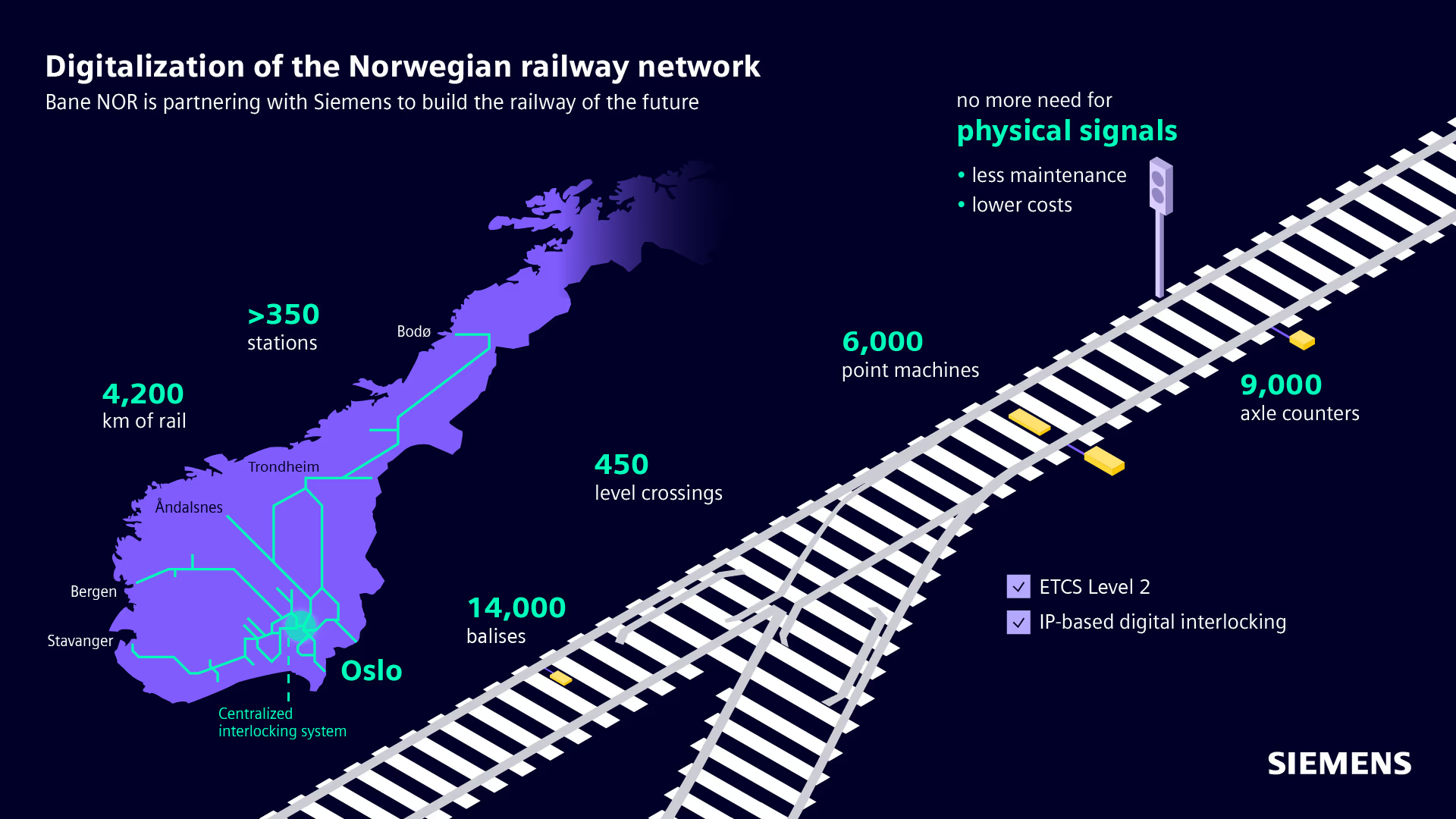
It’s clear from the scale of the project that this will be a task for generations of employees at Siemens Mobility: About 4,200 kilometers of track and more than 350 stations around Norway will be equipped with the European Train Control System ETCS Level 2. The deliverables from Siemens Mobility Management include 6,000 point machines, more than 9,000 axle counters, and 14,000 Eurobalises. More than 450 railroad crossings will be upgraded, and then there’s a 25-year maintenance contract that will take effect when the last stretch of track goes into operation. The contract has a total value of around €800 million.
Trail-blazing and unparalleled investment in ETCS
Like the German high-speed line between Leipzig and Nuremberg, ETCS Level 2 will enable the Norwegian system to do without signals on the tracks in the future. Rueprich firmly believes that “This will substantially simplify maintenance compared to conventional train control systems. Trains and lines will communicate wirelessly. All the relevant information for a moving train will be constantly displayed for the drivers in the cab. For users of the Norwegian rail network, in both passenger and freight transport, this means improved headway and better availability: More vehicles can use the existing network at shorter intervals.”
A further benefit is that Norway will be linked with the Trans European Rail Network. Trains will be able to run from Sicily to Norway without having to change locomotives en route.
A genuine Internet of Things
“Some lengths of track in Norway are still operated entirely manually, with no train control system at all,” Rueprich observes. “But together with Bane NOR we will transform the country’s entire rail network into a fully digitalized, IP-based system – a genuine ‘Internet of Things.’” In a ten-year timeframe Bane NOR will invest more than two billion euros in digitalizing and automating its rail network, as part of the company’s ERTMS (European Rail Traffic Management System) initiative. The objective is to establish a leading position for Norway in the use of digital technologies in the rail sector with the most advanced rail network in Europe. National policy also underpins this ambitious project.
Among those present at the opening ceremony was Nikolai Astrup, Norway’s Minister of Digitalization. “An investment on this scale is extremely rare. I am very fortunate to be able to work on this project. It’s also a real pleasure to work in an atmosphere of openness and trust with the customer and as part of the project team,” comments Rueprich, who has been seconded to Norway but spends at least as much time working for Bane NOR at the Siemens Mobility locations in Braunschweig and Berlin.
The customer shares this view: “Siemens is the main supplier to the Norwegian ERTMS program with their interlocking and radio block center (RBC). The Siemens solution is leading edge based upon an IP based architecture. With a strong technical roadmap and a proved ability to deliver, Siemens is the ideal partner for Bane NOR in this challenging program. We are thrilled to work together with Siemens to develop the digital rail,” says Sverre Kjenne, Executive Vice President Digitalization and Technology, Bane NOR.
“The Siemens solution is leading edge based upon an IP based architecture. With a strong technical roadmap and a proved ability to deliver, Siemens is the ideal partner for Bane NOR in this challenging program.”
New testing and training center
Bane NOR, and the other participants in the project, France’s Thales Group, which will supply the traffic management system (TMS) for the project; Alstom, the contractor for the onboard units (OBU); and Siemens Mobility, are all pleased to have reached an important milestone on time: on October 31, 2019, they officially opened the testing center and subsequent training center – “Campus Nyland” – in Grorud, a suburb of Oslo.
Digital twin of the rail infrastructure
The testing center is already in operation, and contains the central interlocking system and ETCS (European Train Control System), and other system components. The first phase will involve testing the generic system: “Before we go live, we must thoroughly test all the systems from a safety perspective and run through all possible scenarios,” comments Rueprich. “And we can do all that here in the test lab.” Some tests are performed in the identical Siemens testing center in Braunschweig. But, notes Rueprich, the customer considered it important to maintain a center of competence in their own country, too.
What about the outdoor systems and the real-life railroad lines? The project team simulates those digitally using BIM (Building Information Modeling) technology, in other words, with a Digital Twin. Rueprich explains how it works: “We first scan the railway infrastructure using cameras, Lidar – a kind of three-dimensional radar – and GPS, fitted to a modified locomotive. We use this data to create a digital rail layout that we import into our engineering tools.” In the second and last testing phase, the team tests the technologies, either directly on the rails or at the individual stations.
Where to from here?
The Nyland training center will open its doors in the fall of 2021, to begin training the customer’s maintenance crews in time for the introduction of the new technology. The interesting aspect in this case is that the training center is not in the open air, which is normal practice in other locations, but is contained within a hall to protect it from the elements. In an area of around 900 square meters, it contains a track, a station, and everything else needed for training purposes. That means the training sessions can be held all year round, regardless of the weather.
Siemens Mobility will gradually digitalize the entire Norwegian rail network and provide a staged sequence of training to the customer’s employees. "Norway is on track to become the first country to operate in the “one country, one interlocking” architecture making it at the forefront of digitalization. Our intelligent infrastructure will ensure that the system operates efficiently. The digital interlocking, with IP controlled field components, and ERTMS are the backbone to greatly improving operations and maintenance. This architecture also opens the door for future developments such as implementing driverless technologies, moving the interlocking to the cloud, which would make proprietary hardware and spare parts a relic of the past, and would make data instantaneously available to transportation operators,” stated Michael Peter, Siemens Mobility CEO. “Campus Nyland is an important milestone in turning this vision into reality."