Velaro Novo – interviews with the experts
Would you like to learn about the innovations in the new Velaro Novo and everything that’s behind them? In our series of interviews, we introduce you to Velaro Novo experts talking about their specialty, from the test car and aerodynamics to the interior design. Check in on a regular basis and discover new Expert Talks.
Championing the Velaro Novo
The Velaro Novo takes all of the knowledge and experience gained from the Eurostar project and puts that into creating something that’s going to be really transformational for passengers and operators.


How we support the Eurostar from its introduction and over the entire lifecycle is key to improving reliability. As we gain experience, we build up the expertise and capability to further improve performance.
Good news for operators
All in all, it was possible to reduce maintenance costs by a total of 30 percent. To achieve this, cost efficiency was an important criterion right from the start during development of the new high-speed train. Tom Kutscher, head of sales for high-speed and intercity trains at Siemens Mobility, played a key role in turning the Velaro Novo into an economically attractive complete package. To ensure that the Velaro Novo remains profitable for operators over the whole lifetime, it was necessary to rethink the train’s economic efficiency and put different key performance indicators to the test. “Not only did we rethink the vehicle concept but we also took a close look at e.g. the maintenance intervals,” Kutscher says.
Operators can react flexibly to requirements while also keeping costs low.
With the Velaro Novo, we offer our customers tangible and measurable benefits.

One special new development in the vehicle concept is the Velaro Novo’s scalable traction. This innovation also closes a gap in Siemens’ portfolio. “We have the ability to also offer the Velaro Novo at competitive prices at a speed of 250 km/h. This is an enormous advantage,” Kutscher explains. Five years after the project was launched, he’s achieved his goal to make the Velaro Novo more economically attractive. “The Velaro Novo is part of the Velaro evolution and yet also an entirely new product because we took a completely different approach – one that is very closely aligned with our customers’ economic needs.”
Out of enthusiasm for rails
More room for passengers
When it comes to designing interiors, the Velaro Novo is setting new standards in passenger experience and flexibility. The available space has been increased by 10 percent. One key to this is the empty tube concept. This means that the train has no permanently built-in technical equipment, and the interiors can be designed entirely according to the customer’s wishes. While this concept was also applied to previous models, “we’ve now made the empty tube even emptier, compared to the Velaro,” says Ben Dobernecker, who played a key role in giving both passengers and train operators more space in the new Velaro Novo. “We’ve also made the cars longer. As a result, the train has the same length but one car less and thus eliminates one of the inter-car gangways,” explains Dobernecker. This new design gives customers even greater freedom in arranging the interiors.
A 200 meter train now provides 188 meters of space. As a result, more or less the entire train belongs to the passenger.
With the Velaro Novo, we’ve moved away from previous conventions and taken the concept one step further.
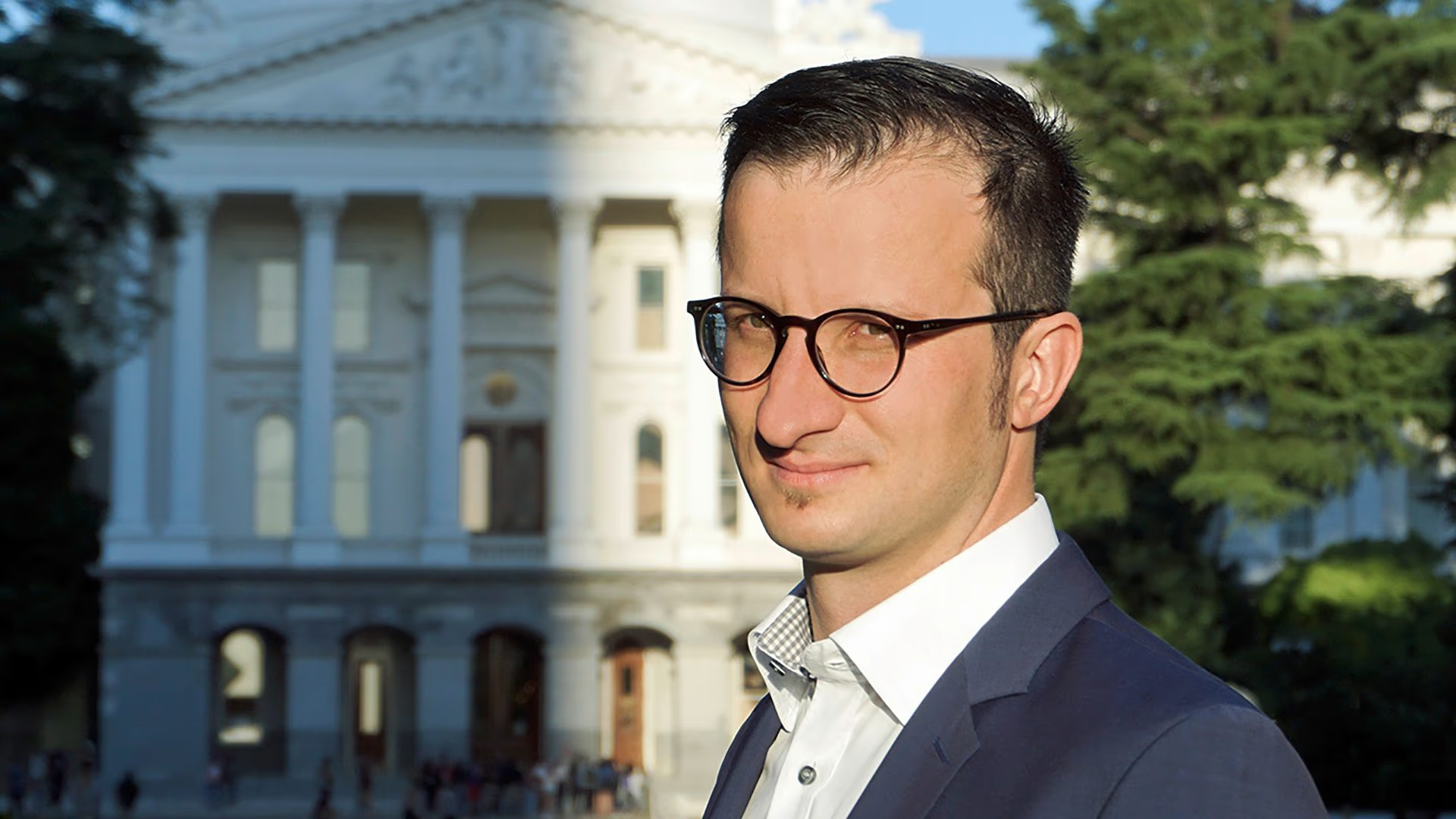
As a Business Development Manager for North America, Ben Dobernecker not only explores new possibilities for train operators but also considers the passengers. “When it comes to passenger experience, we take a look at the passenger’s entire journey, from the moment he leaves home to when he reaches his destination. The Velaro Novo is one part of this journey.” From window cutouts to interior lighting, and from table holders to ticket apps, Ben Dobernecker and his team continue to work on exceeding the standards of passenger comfort with the Velaro Novo. “We want to offer not just a train but a comprehensive mobility solution.”
Perfected aerodynamics
The primary goals of the aerodynamics experts in Krause’s team were to reduce aerodynamic drag and increase crosswind stability – tasks that require not only expertise but also meticulous care and persistence, because the technological value of the Velaro Novo lies in minute details: “In the case of the bogie housings, for example, we wrangled over every millimeter, and sometimes even over half a millimeter. With this measure alone, we improved aerodynamic drag by 15 percent,” explains Krause.
We achieved a great success that far exceeds anything that existed before. I believe, in terms of aerodynamics, we’ve built the best train in the world.
Unlike cars or planes, the Velaro Novo operates bidirectionally at maximum speed. That means that every aerodynamic measure has to work in both directions of travel.

Economic efficiency and passenger experience go hand in hand
Already on track before the first trip
The best of both worlds: Digitalization and test drive
Equipped with hundreds of sensors, the test car tagged “#seeitnovo” draws attention. Inside, it mostly contains measuring equipment. Naturally, there are people on board. But they’re exclusively measurement technicians. “We realized that digital simulation can’t be the only way. It can only be a means of support,” said Rene Trosiner, technical manager at Siemens Mobility and specialist for the Novo test car. So, Trosiner and his team decided to do something that’s a bit unusual given today’s simulation technologies and digitalization solutions. They actually built a non-self-propelled rail car and run it in test operations. More than 100 employees were involved in the development of the new train solution, as well as the construction of the measurement car.
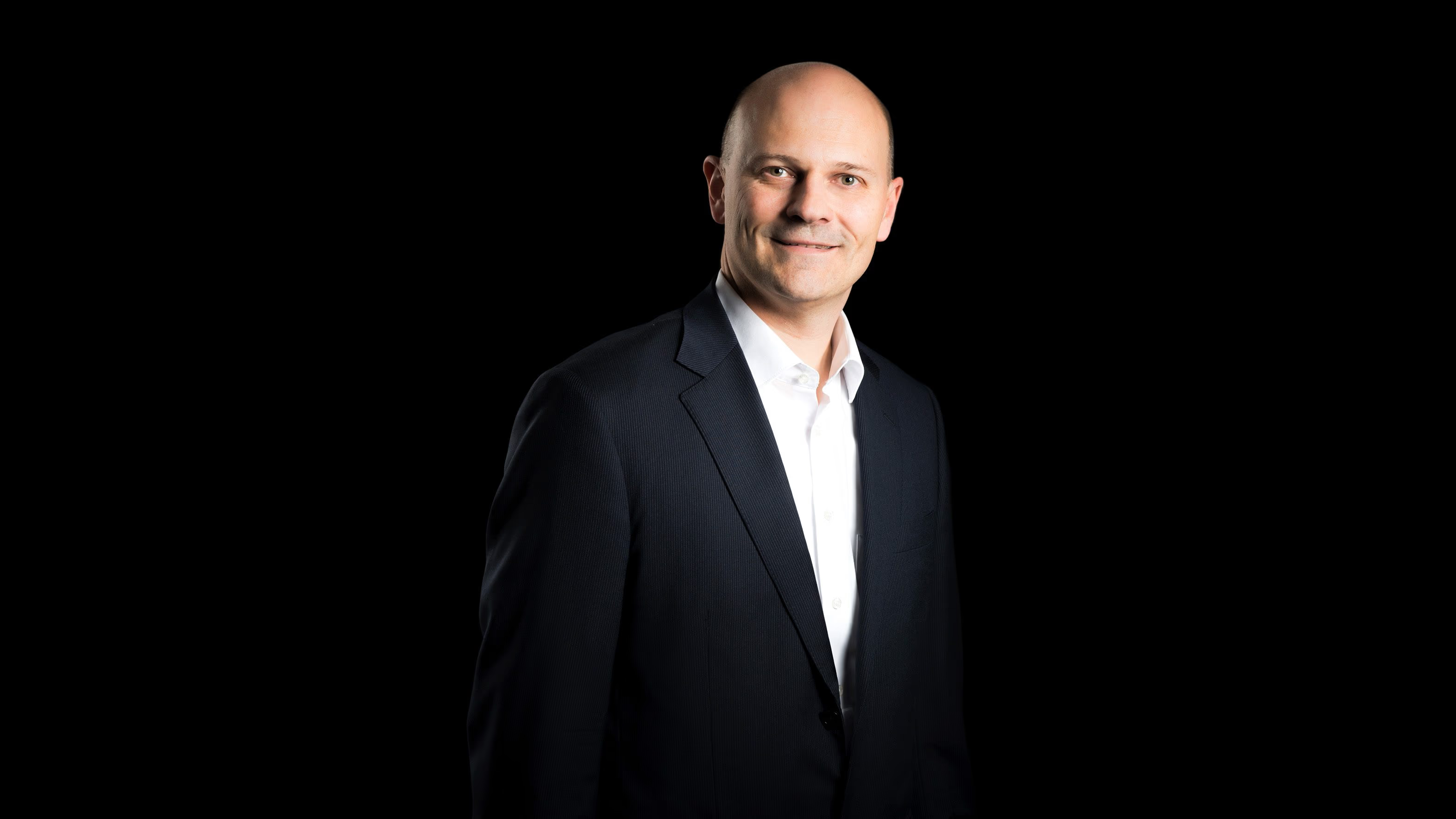
For us, completely rethinking things meant starting with a blank page and redefining the general conditions that would apply.
Getting to the idea of a new train also came from rethinking: “In principle, we cut ourselves loose from the general conditions we applied up until now,” said Trosiner. This way of thinking created an opportunity to develop a train that is rethought from concept to engineering. A train that, he is sure, will impress. Because of this, Trosiner will be on the test drive. “To experience, firsthand, what the entire team has designed and accomplished is definitely something very special for me,” he expressed.
Follow #seeitnovo in social media. And, with a little luck, you can discover the Novo test car for yourself as it travels through Germany.