Communications Based Train Control (CBTC)
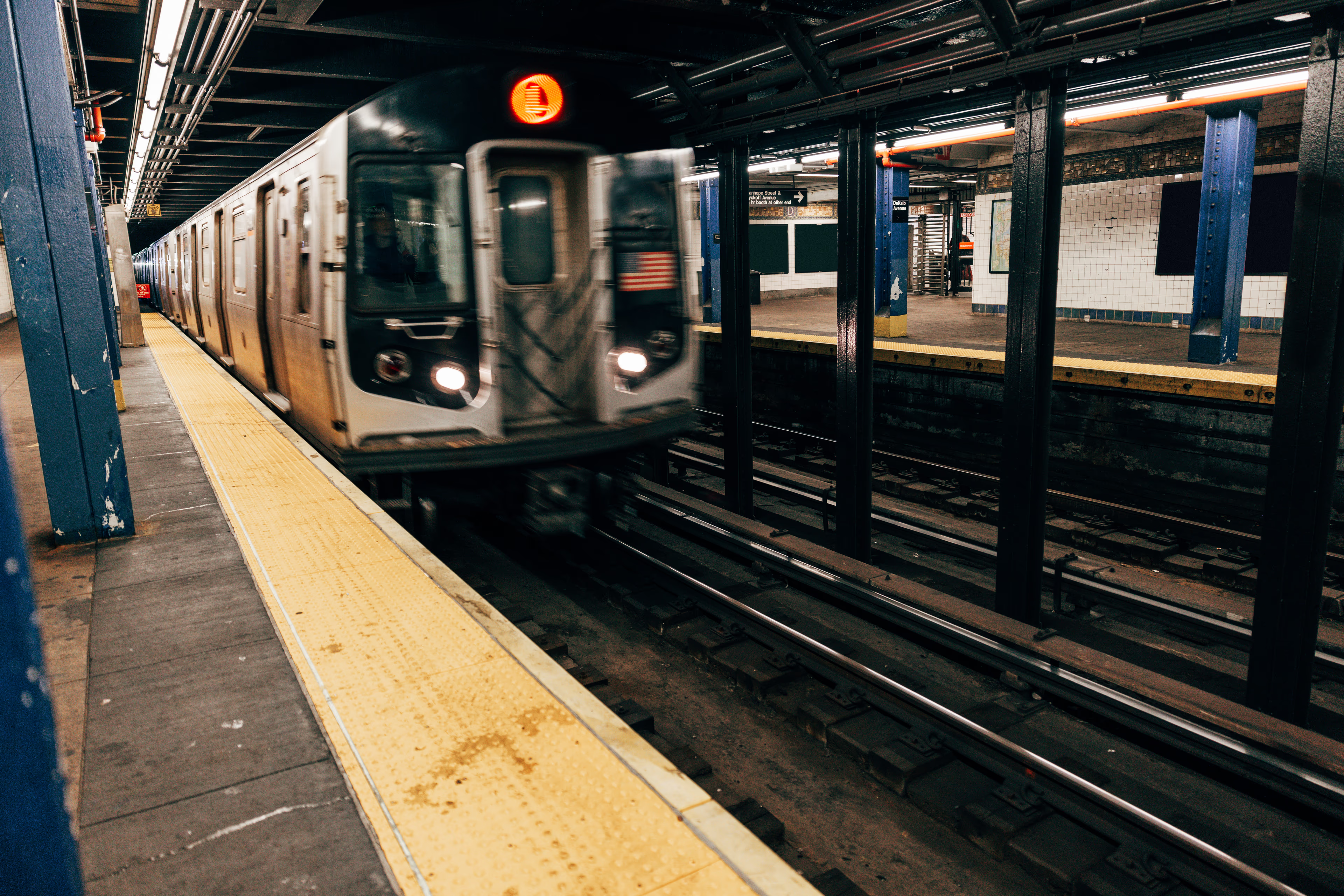
With cities growing, the need for efficient mass transit systems continues to grow. As operators work to accommodate more passengers, maintaining high levels of safety, punctuality, convenience, and energy efficiency is crucial. Our Trainguard MT, the world’s leading automatic train control (ATC) system, helps operators meet customer demands today while transforming tomorrow.
With cities growing, the need for efficient mass transit systems continues to grow. As operators work to accommodate more passengers, maintaining high levels of safety, punctuality, convenience, and energy efficiency is crucial. Our Trainguard MT, the world’s leading automatic train control (ATC) system, helps operators meet customer demands today while transforming tomorrow.
High-performing CBTC system
Higher performance
Trainguard MT lets operators maximize network capacity and throughput. They can achieve headways of 90 seconds or less by combining the real moving-block principle of train separation with continuous, bi-directional communication and free-propagation radio. This increases the number of trains in operation, which transport more passengers at the same time. Service is more punctual and passenger satisfaction is higher.
Better scalability
Because Trainguard MT can operate at different train control levels, it is highly scalable in terms of functions, performance and costs. Continuous train control is used in metropolitan areas, where minimal headways and short train intervals are essential. Intermittent train control is used in suburban and commuter areas, where the required headways and train intervals are medium.

Reduced lifecycle costs
By minimizing the number of outdoor elements and operating trains with an energy-optimal driving algorithm, Trainguard MT optimizes lifecycle costs. Its fully electronic computer boards are maintenance-free, and its Trackside transponders are also maintenance-free and don’t need external power supply or battery power.
Mixed traffic / mixed mode
Trainguard MT is the optimum choice for mixed-traffic environments, including normal, express, suburban, mainline or freight trains. It can operate trains with and without drivers on the same route simultaneously. It can also handle trains with different train control equipment at the same time in the same network, so mixed fleets can operate alongside each other.
Train control methods and levels of automation
Trainguard MT is a versatile, modular system that can be tailored to the railway operator’s needs. Performance and functionality requirements determine the train control and automation levels to be implemented. The following control levels can be used jointly or separately.
Continuous train control (CTC)
Trainguard MT with CTC features a bi-directional radio transmission channel, real moving-block functionality and comprehensive automatic train operation (ATO). System performance is enhanced significantly when the moving-block principle is used to create minimum headways. Color light signals can be reduced or omitted completely. In CTC operation, intelligent ATO algorithms optimize energy consumption.
Intermittent train control (ITC)
Intermittent track-to-train communication allows fixed-block operation with continuous supervision. It also has ATO functionality. The ITC level can be used in areas with lower headway requirements or as a temporary system during refurbishment and switchover.
Interlocking train control (IXL)
Trainguard MT also supports fall-back levels. IXL can provide basic signaling functions in degraded situations.
Semi-automated train operation (STO)
While the driver initiates departure from each station, the train is driven automatically between stations.
Driverless train operation (DTO)
Train movements are fully automated, so a driver is no longer required. Trainguard MT handles passenger transfer, automatic departures and reversals with an attendant onboard in case of emergencies.
Unattended train operation (UTO)
Trainguard MT automatically controls all departures and arrivals, including door closing and opening. Because no staff is onboard, additional safety-related measures are necessary.