Siemens Mobility Training Solutions
We can equip your organisation with the knowledge and skills to maximise the capabilities of our products, equipment and software through dedicating training, resulting in a strong return on investment.

We can equip your organisation with the knowledge and skills to maximise the capabilities of our products, equipment and software through dedicating training, resulting in a strong return on investment.
What we do
We provide dedicated technical and competency-based training to our staff and customers for courses relating to a wide range of signalling systems and products.
Our trainers are Certificate IV qualified with extensive railway and domain experience. We meld modern competency-based training techniques with trainers that have a demonstrated credibility in railway signalling and an ability to relate to course participants. The courses and training style are a combination of theory and practical exercises that provide a hands-on approach; ensuring participants can get the most from the training.
We also develop customised training solutions to meet your business and project needs to ensure your teams have the knowledge and skills to use products and equipment appropriately when they are out in the field. Training can also be conducted at our customers’ site, a project site or a Siemens Mobility office in Australia and New Zealand.
Product training and Refresher training course catalogue
Discover the power of Siemens rail technology with us!
We’re dedicated to advancing railway safety and efficiency, which includes helping you and your team to master the innovative technologies that make it possible. From track vacancy detection with our advanced axle counter system, Clearguard, to the precise control of points with Switchguard point machines, we cover every critical component.
Our training programs are designed to empower you with the knowledge and skills needed to operate, maintain, and optimize these cutting-edge products and solutions, ensuring safe and efficient railway operations for everyone. Join us and become an expert in the technologies that keep the world moving!
Axle counting systems (Clearguard)
Clearguard - The Siemens Axle Counter System is used for track vacancy detection on main and secondary lines with any traction type, any track section length and speeds up to 450 km/h. It can be connected to any interlocking system

Course details
The Siemens ACM 250 Axle Counter System is used for track vacancy detection on main and secondary lines with any traction type, any track section length and speeds up to 450 km/h. It can be connected to any interlocking system.
Related Products
ZP D 43
PSO 4000
Course Description
The Clearguard® ACM 250 Design course is conducted on the customer’s installation (or in our training room) and is presented over two days with a maximum of 8 participants, utilising a fully working system.
Theoretical training consists of an exploration of ACM 250 operating principles supported with visuals, while practical training, the major component of this course, comprises the production of application designs, the use of diagnostic tools, configuring and programming a Clearguard® ACM 250 system and, if possible, an on-site inspection.
We continuously assess each participant´s competency during the training.
Course Content
In addition to design elements, the course addresses standard and peripheral equipment, connectivity options and configuration steps. In addition, it addresses alarm configuration and management.
Duration
The Clearguard® ACM 250 Design course will occupy two days.
Required Pre-Knowledge
Participants should have:
- A working knowledge of PCs
- Access to a laptop with administrative rights to set a fixed IP address and Java 8 installed
- A basic understanding of networked communications
Certification issued
A certificate of competency will be issued to all students who achieve satisfactory performance in this course.
Refresher Training
Certification for this course expires four years after completion. In the interim, a refresher course is available in the intervening two years. Delivery methods for the refresher may include In-person or Online delivery to provide assurance of continuing competency.
Target audience
This course provides Railway Signalling Engineers with skills to design simple and complex Clearguard® ACM 250 applications.
Learning outcomes
- Describe the ACM 250 System
- Describe the ACM 250 performance features
- Identify the features of the ACM250
- Recognise the potential safety issues arising from changes in the field
- Analyse counting requirements
- Determine appropriate locations for counting equipment
- Configure track vacancy sections
- Configure Sequencing and the actions to take
- Demonstrate the display elements of the Configuration Data
- Configure the Website Interface
- Configure data connectivity and reset provisions
Course details
The Siemens ACM 250 Axle Counter System is used for track vacancy detection on main and secondary lines with any traction type, any track section length and speeds up to 450 km/h. It can be connected to any interlocking system.
Related Products
ZP D 43
PSO 4000
Course Description
This is a theoretical and a practical based course that provides maintainers with the skills to install and fault-find the ACM 250 Axle Counter System. The Clearguard® ACM 250 First Line Maintenance course is conducted on the customer’s installation (or in our training room) and is presented over two days with a maximum of eight participants.
Theoretical training consists of an exploration of ACM 250 operating principles supported with visuals.
Practical training, the major component of this course, consists of installation, calibration, correspondence, maintenance and fault-resolution – via Diagnostic Web Site – of the ACM 250. We provide each participant with a copy of the ACM 250 Axle Counter System manuals and we continuously assess each participant’s competency during the training and issue a Certificate of Competency to participants demonstrating competency.
Course Content
The course addresses standard and peripheral equipment, connectivity options and configuration steps. In addition, it addresses alarm configuration and management.
Duration
In conjunction with the ZP D 43 First Line Maintenance course, the Clearguard® ACM 250 First Line Maintenance course will occupy two days.
Required Pre-Knowledge
Participants should have:
- Authority to access railway sites
- Access to a laptop with administrative rights to set a fixed IP address and Java 8 installed
- A basic understanding of networked communications
- Demonstrated competence in maintaining signalling systems
Certification issued
A certificate of competency will be issued to all students who achieve satisfactory performance in this course.
Refresher Training
Certification for this course expires four years after completion. In the interim, a refresher course is available in the intervening two years. Delivery methods for the refresher may include In-person or Online delivery to provide assurance of continuing competency.
Target audience
This course is for Railway Signalling Maintainers with existing rail and maintenance experience who will be responsible for installation or maintenance of the ACM 250 Axle Counter System.
Learning outcomes
- Describe the ACM 250 System
- Describe the ACM 250 performance features
- Identify ambient conditions and the actions to take
- Recognise indoor equipment and the actions to take
- Discuss higher level systems and actions to take
- Identify the features of the ACM250
- Recognise the potential safety issues arising from changes in the field
- Interpret safety-related configuration aspects within the context of your procedures
- Describe the ACM 250’s Diagnostic Facilities
- Demonstrate the interpretation of the front panel LEDs
- Demonstrate the interpretation of the Web Page diagnostics
- Describe the safety precautions associated with ACM 250 corrective maintenance
- Demonstrate corrective maintenance of the ACM 250
- Demonstrate preventative maintenance of the ACM 250
Course details
The Clearguard® ZP D 43 electronic wheel detection equipment is a wheel detection component for use in track vacancy detection systems using the axle counting method. It is used in the outdoor equipment of the Clearguard® ACM 2xx counting systems and comprises a DEK 43 double wheel detector and a trackside connection box.The DEK 43 double wheel detector is made up of two transmitters and two receivers accommodated in separate housings. The housings are mounted opposite each other with a reducing plate against the rail web on the inside and outside.The trackside connection box of the Clearguard® ZP D 43 consists of a lower part and a cover which is made of either plastic or aluminum (selectable). The lower part supports a board module which in turn comprises a base plate, the application-specific printed circuit board and a protective cover.
Related Products
Clearguard® ACM 200
Clearguard® ACM 250
Clearguard® PSO 4000
Course Description
This is a theoretical and a practical based course that provides maintainers with the skills to install and fault-find the ZP D 43 Axle Detection System. The Clearguard® ZP D 43 First Line Maintenance course is conducted on the customer’s installation (or in our training room) and is presented over two days with a maximum of eight participants in conjunction with the ACM250 FLM course.
Theoretical training consists of an exploration of ZP D 43 operating principles supported with visuals.
Practical training, the major component of this course, consists of installation, calibration, maintenance and fault-resolution of the ZP D 43. We provide each participant with a copy of the ZP D 43 Axle Counter System manuals. We continuously assess each participant’s competency during the training and issue a Certificate of Competency to participants demonstrating competency.
Course Content
The course addresses standard and peripheral equipment, connectivity options and configuration steps.
Duration
In conjunction with the Clearguard® ACM 250 First Line Maintenance course, the Z D 43 course will occupy two days.
Required Pre-Knowledge
Participants should have:
- Authority to access railway sites
- Access to a laptop with administrative rights to set a fixed IP address and Java 8 installed
- A basic understanding of networked communications
- Demonstrated competence in maintaining signalling systems
Certification issued
A certificate of competency will be issued to all students who achieve satisfactory performance in this course.
Refresher Training
Certification for this course expires four years after completion. In the interim, a refresher course is available in the intervening two years. Delivery methods for the refresher may include In-person or Online delivery to provide assurance of continuing competency.
Target audience
This course is for Railway Signalling Maintainers with existing rail and maintenance experience who will be responsible for installation or maintenance of the ACM 250 Axle Counter System.
Learning outcomes
- Describe the Z D 43
- Describe the safety risks relating to the ZP D43
- Describe the Function and Structure of the Wheel Detection Equipment
- Describe the installation process for the double wheel detector
- Describe the installation process of the trackside connection box
- Demonstrate the process of commissioning wheel detection equipment
- Demonstrate the wheel detection equipment’s functional integrity
- Identify Tools for maintenance
- Apply Inspection and preventive maintenance
- Perform Diagnostics
- Perform Corrective maintenance
Course details
The Clearguard® Phase Shift Overlay Track Circuit (PSO 4000) is a multiple code modulated, audio frequency overlay track circuit, compatible with most other equipment. It is typically used for level crossing control and release tracks and has the benefit of not requiring insulated rail joints.The PSO 4000 is site configurable for frequency, function and set up and comes as a transmitter, receiver, repeater and crossing (two receivers, a complete island, stick circuits and stick release timers). Peripheral equipment permits operation over other existing track circuits that may also be present for signalling purposes.The PSO 4000 is a reliable and secure system that will operate in conjunction with most other track equipment.
Related Products
ZP D 43
ACM250
Course Description
This is a theoretical and a practical based course that provides installers and maintainers with the skills to use the PSO 4000.
Course Content
The Clearguard® PSO 4000 Installation and First Line Maintenance course is conducted on the customer’s installation (or in our training room) and is presented over a half day with a maximum of eight participants. Theoretical training consists of the PSO 4000 operating principles supported with visuals. Practical training, the major component of this course, consists of setting a PSO 4000 to work and measuring typical voltages.
We give each participant a copy of the PSO 4000 manuals and continuously assess participant’s competency during the training and issue a Certificate of Competency to participants demonstrating competency
Duration
The Clearguard® PSO4000 First Line Maintenance course will occupy one day.
Required Pre-Knowledge
Participants should have:
- Railway authority to enter sites and access equipment under instruction
- Railway signalling maintenance and operational procedure experience
Certification issued
A certificate of competency will be issued to all students who achieve satisfactory performance in this course.
Refresher Training
Certification for this course expires four years after completion. In the interim, a refresher course is available in the intervening two years. Delivery methods for the refresher may include In-person or Online delivery to provide assurance of continuing competency.
Target audience
This training course provides commissioning and maintenance personnel with the knowledge and skills to install commission and maintain PSO 4000 track circuits.
Learning outcomes
On completion of this course, participants will be able to:
- Perform Clearguard PSO 4000 Installation and First Line Maintenance
- Describe the operation of a PSO track circuit
- Describe differences between overlay and DC track circuits
- Describe the functions of PSO 4000 equipment
- Describe the functions of PSO 4000 peripheral equipment
- Identify typical configurations
- Demonstrate how to set up a PSO track circuit
- Describe the maintenance requirements for a PSO track circuit
- Describe and demonstrate fault finding methods
- Demonstrate how to replace PSO track circuits
- Download a log using HyperTerminal and Diagnostic Terminal (DT)
Level Crossing Products (Wayguard)
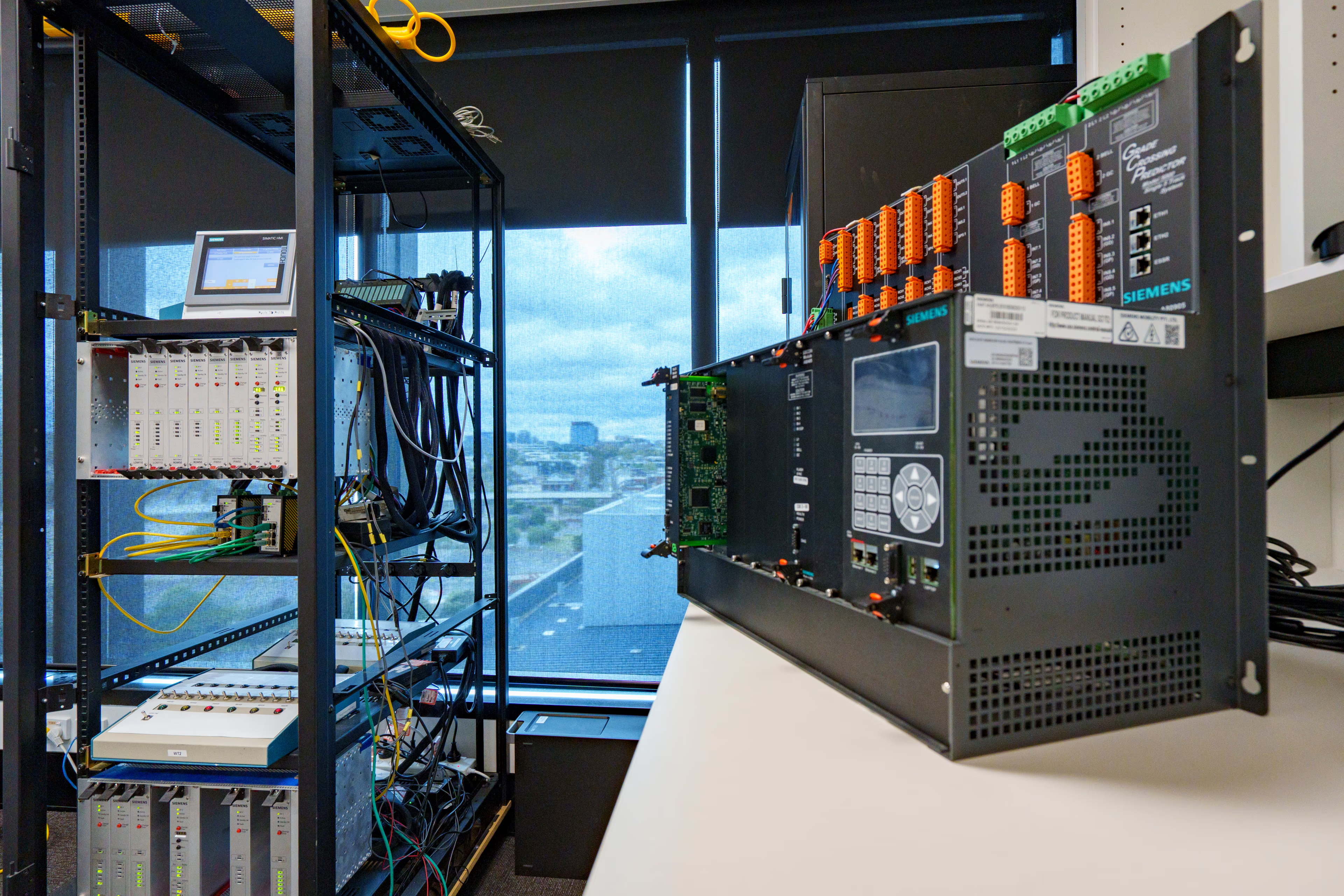
Wayguard - The Grade Crossing Predictor and Boom Gate mechanism devices are designed to detect trains approaching a level crossing and based on the calculated speed of the train, activate the crossing for the intended warning time
Course details
The GCP 3000 devices are designed to detect trains approaching a level crossing and based on the calculated speed of the train, activate the crossing for the intended warning time.
Related Products
Wayguard® S-40, S-60 and S-80 Boom Gate Mechanisms
SEAR II and Iii
GCP 4000 and 5000
Course Description
This theoretical and practical course is designed to give the student the skills to install and maintain GCP 3000 equipment. Students are introduced to the fundamentals of level crossings and are encouraged to plan equipment swap-outs and diagnose GCP and track faults. At least one GCP unit will be available for students to work with.
Course Content
This is a theoretical and a practical based course that provides up to eight maintainers with the skills to maintain a Wayguard® 3000 GCP system. The Wayguard® GCP 3000 First Line Maintenance course is conducted with demonstration GCP 3000 installations. Theoretical training consists of the basic GCP 3000 and peripherals operating principles supported with visuals. Practical training, the major component of this course, consists of using diagnostic tools, configuring a GCP 3000 system, analysis of logs and on-site instruction.
Duration
The Wayguard® GCP 3000 First Line Maintenance course will occupy two and a half days.
Required Pre-Knowledge
Participants should have:
- Railway Authority to enter sites and access equipment under instruction
- A thorough understanding of railway operation rules and practices as applicable to first line maintenance
- A working knowledge of PCs (and preferably a working PC and suitable connection cable)
Certification issued
A certificate of competency will be issued to all students who achieve satisfactory performance in this course.
Refresher Training
Certification for this course expires four years after completion. In the interim, a refresher course is available in the intervening two years. Delivery methods for the refresher may include In-person or Online delivery to provide assurance of continuing competency.
Target audience
The Wayguard® GCP 3000 First Line Maintenance course is for Railway Signal Electricians and Maintainers who maintain GCP 3000 equipment.
Learning outcomes
- Describe the functions of the GCP 3000 modules
- Read and interpret module displays and LEDs
- Describe the connection requirements for the GCP 3000
- Use the Keyboard Display to configure the system
- Set up, configure and re-commission a system
- Use the Keyboard Display to interrogate and interpret the system
- Download, read and interpret GCP 3000 system logs
- Replace defective modules
The GCP 4000 and 5000 devices are designed to detect trains approaching a level crossing and based on the calculated speed of the train, activate the crossing for the intended warning time.
Related Products
Wayguard® S-40, S-60 and S-80 Boom Gate Mechanisms
SEAR II and Iii
Wayguard® GCP 3000
Course Description
This theoretical and practical course is designed to give the student the skills to install and maintain GCP 4000 and 5000 equipment. Students are introduced to the fundamentals of level crossings and are encouraged to plan equipment swap-outs and diagnose GCP and track faults. At least one GCP unit will be available for students to work with.
Course Content
This is a theoretical and a practical based course that provides up to eight maintainers with the skills to maintain a Wayguard® 4000/5000 GCP system. The Wayguard® GCP 4000/5000 First Line Maintenance course is conducted with demonstration GCP 4000 and 5000 installations. Theoretical training consists of the basic GCP 4000/5000 models and peripherals operating principles supported with visuals. Practical training, the major component of this course, consists of using diagnostic tools, configuring a GCP 4000/5000 system, analysis of logs and on-site instruction.
Duration
The Wayguard® GCP 4000/5000 First Line Maintenance course will occupy two and a half days.
Required Pre-Knowledge
Participants should have:
- Railway Authority to enter sites and access equipment under instruction
- A thorough understanding of railway operation rules and practices as applicable to first line maintenance
- A working knowledge of PCs (and preferably a working PC and suitable connection cable)
Certification issued
A certificate of successful completion will be issued to all students who achieve satisfactory performance in this course.
Refresher Training
Certification for this course expires four years after completion. In the interim, a refresher course is available in the intervening two years. Delivery methods for the refresher may include In-person or Online delivery to provide assurance of continuing competency.
Target audience
The Wayguard® GCP 4000/5000 First Line Maintenance course is for Railway Signal Electricians and Maintainers who maintain GCP 4000/5000 equipment.
Learning outcomes
- Describe the operation of the GCP 4000/5000
- Describe the functions of the GCP 4000/5000 modules
- Describe the function and application of external peripheral equipment
- Read and interpret module displays and LEDs
- Use the Display Module and a PC to configure, interrogate and interpret the system including logs
- Set up, configure and re-commission a system
- Replace defective modules
- Conduct routine maintenance
The GCP 5000 is designed to detect trains approaching a level crossing and based on the calculated speed of the train, activate the crossing for the intended warning time.
Course details
Related Products
Wayguard® S-40, S-60 and S-80 Boom Gate Mechanisms
Wayguard® SEAR II and Iii
Wayguard® GCP 3000 and 4000
Course Description
This theoretical and practical course is designed to give the student the skills to install and configure GCP 4000 and 5000 equipment. Students are introduced to the fundamentals of level crossings and are encouraged to plan equipment swap-outs and diagnose GCP and track faults. At least one GCP unit will be available for students to work with.
Course Content
This is a theoretical and practical course that provides designers with the skills to design. The Wayguard® GCP 5000 for Designers course is conducted in a training room, with a full working training rig. Preferably there would also be access to an operating GCP 5000 installation. It is presented over five days with a maximum of 6 participants. Theoretical training consists of the basic GCP 5000 operating and application principles delivered by visual projections. Practical training, the major component of this course, comprises the production of application designs, using diagnostic tools, configuring and programming a GCP 5000 system and, if possible, an on-site inspection.
Duration
The Wayguard® GCP 5000 Design course will occupy five days and includes an assessment project on the final day.
Required Pre-Knowledge
Participants should have:
- A thorough understanding of the railway operation rules and practices as applicable to level crossings
- An understanding of general signalling principles
- A working knowledge of PCs
Certification issued
A certificate of competency will be issued to all students who achieve satisfactory performance in this course, including the final assessment.
Refresher Training
Certification for this course expires four years after completion. In the interim, a refresher course is available in the intervening two years. Delivery methods for the refresher may include In-person or Online delivery to provide assurance of continuing competency.
Target audience
This course provides Railway Signalling Engineers with skills to design simple and complex GCP 5000 applications.
Learning outcomes
- Describe the operating principles of the GCP 5000
- Describe typical GCP applications
- Describe the limitations of a predictor
- Calculate the required track distance for a GCP installation
- Select appropriate frequencies for GCP installations
- Describe the purpose of the GCP modules
- Describe the different chassis types
- Describe the power and the track connection requirements
- Define appropriate cable requirements in a GCP installation
- Explain when to use 4 and 6 wire connections
- Describe the application of the required termination shunts and couplers
- Demonstrate how to use Office Configuration Editor for programming
- Develop Boolean logic diagrams
- Demonstrate how to select an appropriate template for a design
- Demonstrate how to adapt templates
- Demonstrate design of typical GCP layouts
- State the methods used to overcome poor shunting
- Demonstrate designs for trains that stop in the approach
- State the different methods of design around points in GCP approaches
- Calculate Post Joint and Advance Approach Prediction
Course details
The SEAR is an intelligent data logging and analysis suite for use with Railway Signalling. It is primarily targeted at monitoring level crossings but can be used for monitoring most signalling installations.
Hardware is installed at each site and configured for the specific application. The hardware could be a standalone unit (SEAR II) or as a module (SEAR IIi) for the Wayguard® GCP 4000 and GCP 5000 full-chassis predictors.The installation may use accessories such as a light out detector, mini trackside sensor and earth leakage adaptor. The Wayguard® SEAR will record all events and determine when alarm conditions exist.A Wayguard® SEAR can communicate alarms to a maintenance centre PC over most media. The Maintenance Centre PC is configured to receive status reports from the field, log then and forward alarm states via SMS or e-mail to the appropriate persons. It also enables a remote user to connect to and interrogate field SEARs.
Related Products
Wayguard® S-40, S-60 and S-80 Boom Gate Mechanisms.
Wayguard® GCP 3000, 4000 and 5000
Course Description
This is a theoretical and practical-based course that provides participants with the skills to use a SEAR II for fault finding and to maintenance. The SEAR II and SEAR IIi First Line Maintenance course is conducted on the customer’s training room (or in our training room) and is presented over half a day with a maximum of eight participants. Theoretical training consists of the SEAR II operating principles supported with visuals. Practical training, the major component of this course, consists of hands-on experience to undertake all configuration functions. This course is generally delivered as an extension to the Wayguard® GCP 3000 or 4000/5000 courses.
Course Content
The course addresses standard and peripheral equipment, connectivity options and configuration steps. In addition, it addresses alarm configuration and management.
Duration
The Wayguard® SEAR First Line Maintenance course will occupy half a day.
Required Pre-Knowledge
Participants should have:
- A good understanding of PCs and the Windows Operating System (including web server)
- A good understanding of the systems to be monitored
- A basic understanding of GCPs – we recommend the Appreciation course first for participants who are not familiar with the product.
Certification issued
A certificate of competency will be issued to all students who achieve satisfactory performance in this course.
Refresher Training
Certification for this course expires four years after completion. In the interim, a refresher course is available in the intervening two years. Delivery methods for the refresher may include In-person or Online delivery to provide assurance of continuing competency.
Target audience
Field and office maintainers who will use SEAR II field and office equipment or remote connections to assist in maintenance of trackside equipment.
Learning outcomes
- State the uses for SEAR
- Identify SEAR’s components
- State the basic operational SEAR’s specifications
- Read the status of SEAR and the Crossing via the front panel or PC
- Demonstrate retrieval and analysis of SEAR logs
- Demonstrate how to perform SEAR maintenance activities
- Change the SEAR battery
- Demonstrate installation of the Executive and Application Firmware
- Set up a SEAR II or SEAR IIi to an installation configuration sheet
Course details
Boom barrier mechanisms provide protection for road vehicles when it is unsafe to cross level crossings. Most barriers are Entrance barriers or Half Arm barriers that are to stop cars entering a crossing but do not fully block off the roadway or prevent exiting. Exit barriers may also used at crossings subject to motorist abuse to prevent motorists zig-zagging around half arm gates.
Related Products
Wayguard® S-60 Boom GateWayguard® S-80 Boom Gate
Course Description
This is a theoretical and practical based course that provides maintainers with the skills to maintain the product.
Course Content
The Wayguard® S40 Crossing Gate First Line Maintenance course is conducted on the customer’s installation (or in our training room) and is presented over half a day with a maximum of eight participants. Theoretical training consists of the S40 Barrier operating principles supported with visuals. Practical training, the major component of this course, consists of adjusting and maintaining the barriers.We provide each participant with a copy of the S40 Instruction and Maintenance manual and continuously assess participants’ competency during the training.
Duration
The Wayguard® S-40 Boom Gate First Line Maintenance course will occupy half a day.
Required Pre-Knowledge
Participants should have:
- Railway authority to enter sites and access equipment under instruction (where the gates are located on a railway)
- A thorough understanding of railway operation rules and practices as applicable to first line maintenance (where the gates are located on a railway)
- General mechanical maintenance expertise
Certification issued
A certificate of competency will be issued to all students who achieve satisfactory performance in this course.
Refresher Training
Certification for this course expires four years after completion. In the interim, a refresher course is available in the intervening two years. Delivery methods for the refresher may include In-person or Online delivery to provide assurance of continuing competency.
Target audience
Railway Signal and other maintainers who currently maintain electromechanical equipment (with railway experience if the gate is on a working railway). The course will build on their existing knowledge of railway operation and enable them to perform first line maintenance on level crossing boom barrier mechanisms.
Learning outcomes
- Describe the operation of the S40 barrier
- Set counterweights & stops for arm horizontal
- Set counterweights & stops for arm vertical
- Adjust barrier down time
- Adjust cam switches
- Verify correct operation of the gate
- Lubricate the mechanism
- Reference other maintenance
Boom barrier mechanisms provide protection for road vehicles when it is unsafe to cross level crossings. Most barriers are Entrance barriers or Half Arm barriers that are to stop cars entering a crossing but do not fully block off the roadway or prevent exiting. Exit barriers may also used at crossings subject to motorist abuse to prevent motorists zig-zagging around half arm gates.
Related Products
Wayguard® S-40 Boom GateWayguard® S-80 Boom Gate
Course Description
This is a theoretical and practical based course that provides maintainers with the skills to maintain the product.
Course Content
The Wayguard® S60 Crossing Gate First Line Maintenance course is conducted on the customer’s installation (or in our training room) and is presented over half a day with a maximum of eight participants. Theoretical training consists of the S60 Barrier operating principles supported with visuals. Practical training, the major component of this course, consists of adjusting and maintaining the barriers.We provide each participant with a copy of the S60 Instruction and Maintenance manual and continuously assess participants’ competency during the training.
Duration
The Wayguard® S-60 Boom Gate First Line Maintenance course will occupy half a day.
Required Pre-Knowledge
Participants should have:
- Railway authority to enter sites and access equipment under instruction (where the gates are located on a railway)
- A thorough understanding of railway operation rules and practices as applicable to first line maintenance (where the gates are located on a railway)
- General mechanical maintenance expertise
Certification issued
A certificate of competency will be issued to all students who achieve satisfactory performance in this course.
Refresher Training
Certification for this course expires four years after completion. In the interim, a refresher course is available in the intervening two years. Delivery methods for the refresher may include In-person or Online delivery to provide assurance of continuing competency.
Target audience
Railway Signal and other maintainers who currently maintain electromechanical equipment (with railway experience if the gate is on a working railway). The course will build on their existing knowledge of railway operation and enable them to perform first line maintenance on level crossing boom barrier mechanisms.
Learning outcomes
- Describe the operation of the S60 barrier
- Set counterweights & stops for arm horizontal
- Set counterweights & stops for arm vertical
- Adjust barrier down time
- Adjust cam switches
- Verify correct operation of the gate
- Lubricate the mechanism
- Reference other maintenance
Course details
Boom barrier mechanisms provide protection for road vehicles when it is unsafe to cross level crossings. Most barriers are Entrance barriers or Half Arm barriers that are to stop cars entering a crossing but do not fully block off the roadway or prevent exiting. Exit barriers may also used at crossings subject to motorist abuse to prevent motorists zig-zagging around half arm gates.
Related Products
Wayguard® S-40 Boom GateWayguard® S-60 Boom Gate
Course Description
This is a theoretical and practical based course that provides maintainers with the skills to maintain the product.
Course Content
The Wayguard® S80 Crossing Gate First Line Maintenance course is conducted on the customer’s installation (or in our training room) and is presented over half a day with a maximum of eight participants. Theoretical training consists of the S80 Barrier operating principles supported with visuals. Practical training, the major component of this course, consists of adjusting and maintaining the barriers.We provide each participant with a copy of the S80 Instruction and Maintenance manual and continuously assess participants’ competency during the training.
Duration
The Wayguard® S-80 Boom Gate First Line Maintenance course will occupy half a day.
Required Pre-Knowledge
Participants should have:
- Railway authority to enter sites and access equipment under instruction (where the gates are located on a railway)
- A thorough understanding of railway operation rules and practices as applicable to first line maintenance (where the gates are located on a railway)
- General mechanical maintenance expertise
Certification issued
A certificate of competency will be issued to all students who achieve satisfactory performance in this course.
Refresher Training
Certification for this course expires four years after completion. In the interim, a refresher course is available in the intervening two years. Delivery methods for the refresher may include In-person or Online delivery to provide assurance of continuing competency.
Target audience
Railway Signal and other maintainers who currently maintain electromechanical equipment (with railway experience if the gate is on a working railway). The course will build on their existing knowledge of railway operation and enable them to perform first line maintenance on level crossing boom barrier mechanisms.
Learning outcomes
- Describe the operation of the S80 barrier
- Set counterweights & stops for arm horizontal
- Set counterweights & stops for arm vertical
- Adjust barrier down time
- Adjust cam switches
- Verify correct operation of the gate
- Lubricate the mechanism
- Reference other maintenance
Point Machines (Switchguard)
Switchguard – The point machine controls the driving, locking and detection of points. It is a dual control machine with a variety of motor options. It is suitable for mainline and yard use. The Mk 3 is the latest iteration of this machine.

Course details
The Switchguard® M23A point machine controls the driving, locking and detection of points. It is a dual control machine with a variety of motor options. It is suitable for mainline and yard use. The Mk 3 is the latest iteration of this machine.
Related Products
Switchguard® M3ASwitchguard® 84M
Course Description
This is a theoretical and practical based course that provides maintainers with the skills to maintain the product.
Course Content
The Switchguard M23A Installation and FLM course is conducted on the customer’s installation (or in our training room) and is presented over two days with a maximum of six participants. Theoretical training consists of the M23A operating principles supported with visuals. Practical training, the major component of this course, consists of adjustment, setup and maintenance of the point machine.
Duration
The Switchguard® M23A First Line Maintenance course will occupy two days.
Required Pre-Knowledge
Participants should have:
- Railway Authority to enter sites and access equipment under instruction
- A thorough understanding of the signalling principles and signalling control as used on the target railway
- Competency in point machine installation and first line maintenance
Certification issued
A certificate of competency will be issued to all students who achieve satisfactory performance in this course.
Refresher Training
Certification for this course expires four years after completion. In the interim, a refresher course is available in the intervening two years. Delivery methods for the refresher may include In-person or Online delivery to provide assurance of continuing competency.
Target audience
This training course is for first line maintenance and installation personnel, competent in maintenance of signalling systems and equipment. The course will build on their existing first line maintenance skills. The course defines the assembly of point machines used on the target railway.
Learning outcomes
- Describe the operation of the M23A point machine
- Install an M23A point machine
- Adjust the throw, locking and detection adjustments on M23A point layouts
- Fault find on M23A point machines
- Remove and replace M23A components
- Commission a M23A point machine to return to service
- Demonstrate routine maintenance on M23A point machines
- Re-hand a M23A points machine
Interlocking and monitoring systems (Controlguide and Trackguard)
Controlguide This PC tool provides a graphical display of a controlled section of the railway, showing current and historical movements of trains and configured trackside equipment. The tool is used by signal maintainers with WESTRACE, SSI, MicroLok and relay interlockings.
Trackguard – WESTLOCK and WESTRACE are latest generation interlocking that integrates proven Solid State Interlocking functionality onto a proven, commercial, high integrity, high availability and high reliability platform. The system uses modular redundant hardware with diversity in each channel and meets the latest safety standards for SIL 4 railway systems.

Course details
MoviolaW is a tool used by signal maintainers with WESTRACE, SSI and relay interlockings. This PC tool provides a graphical display of a controlled section of the railway, showing current and historical movements of trains, and configured Trackside equipment. MoviolaW provides full access to all of WESTRACE’s fault and event monitoring functions and to all SSI fault reports that are sent to the technician’s workstation. The maintainer can view all faults in real time or replay logged events to investigate incidents. MoviolaW can also interpret and log selected external failures (e.g. lamp failures) using English text. MoviolaW is generally installed at an interlocking. Signal maintainers and engineers can interrogate installations remotely or by using similar software installed on remote PCs.
Related Products
Trackguard® WESTLOCK
Course Description
This is a theoretical and practical based course that provides participants with the skills to configure, test and maintain local and remote MoviolaW terminals.
Course Content
The Controlguide® MoviolaW for Designers course is conducted in the customer’s training rooms (or in our training room) and is presented over three days with a maximum of six participants.
Theoretical training consists of an introduction to MoviolaW, interface with the interlocking and configuring a PC for local and remote use. Practical training consists of installing a simple MoviolaW, connecting a terminal to a WESTRACE and successful communication with a WESTRACE system. We provide each participant with a copy of the MoviolaW manual. The instructor will continuously assess participant’s competency during the training.
Duration
The Controlguide® MoviolaW for Designers course will occupy three days and includes assessment projects throughout the course.
Required Pre-Knowledge
Participants should have:
- A thorough understanding of the railway operation rules and practices as applicable to interlocking
- An understanding of general signalling principles
- A working knowledge of PCs
Certification issued
A certificate of competency will be issued to all students who achieve satisfactory performance in this course, along with successful completion of the various projects throughout the course.
Refresher Training
Certification for this course expires four years after completion. In the interim, a refresher course is available in the intervening two years. Delivery methods for the refresher may include In-person or Online delivery to provide assurance of continuing competency.
Target audience
This training course is for railway signal or control systems engineers, who have a general understanding signalling and communications systems. This course will build on the engineers’ existing knowledge of operating rules, standards and installations to enable them to configure, test and maintain local and remote MoviolaW terminals.
Learning outcomes
- On completion of this course, participants should be able to:
- Set up a PC with MoviolaW—operating system and software
- Configure local and remote MoviolaW terminals
- Connect MoviolaW terminal to an Interlocking
- Test MoviolaW displays
- Replay events from current and historical
Course details
MoviolaW is a tool used by signal maintainers with WESTRACE, SSI, MicroLok and relay interlockings. This PC tool provides a graphical display of a controlled section of the railway, showing current and historical movements of trains and configured trackside equipment. MoviolaW provides access to WESTRACE’s and MicroLok’s fault and event monitoring functions and to all SSI fault reports that are sent to the technician’s workstation. The maintainer can view all faults in real time or replay logged events to investigate incidents. MoviolaW can also interpret and log selected external failures (eg lamp failures) using English text.MoviolaW is generally installed at an interlocking. Signal maintainers and engineers can interrogate installations remotely or by using similar software installed on remote PCs.
Related Products
Trackguard®WESTLOCK
Course Description
This is theoretical and practical based course that provides MoviolaW users with the skills to access and diagnose a signalling system’s status.
Course Content
The Controlguide® MoviolaW for Maintainers course is conducted either in our training room or in the customer’s training room and is presented over one day with a maximum of eight participants. Practical training, the major component of this course, consists of using a real or simulated interlocking and MoviolaW to gain the basic MoviolaW user skills. It includes, where possible, a visit to a functional MoviolaW terminal to interrogate the signalling system. Remote MoviolaW terminal skills are introduced using direct network connection or a phone line and access to a functional or demonstration local MoviolaW PC.
Duration
The Controlguide® MoviolaW First Line Maintenance course will occupy one day and includes assessment projects throughout the course.
Required Pre-Knowledge
Participants should have:
- A thorough understanding of the signalling principles and signalling control as used on the target railway
- Understanding of the target interlocking system including information available and typical faults
- Competency with PCs and Windows
Certification issued
A certificate of competency will be issued to all students who achieve satisfactory performance in this course, along with successful completion of the various projects throughout the course.
Refresher Training
Certification for this course expires four years after completion. In the interim, a refresher course is available in the intervening two years. Delivery methods for the refresher may include In-person.
Target audience
This course is for Railway signal engineers and maintainers, competent in first line maintenance. It builds on the engineers’ and maintainers’ existing vital and non-vital signalling knowledge. This course is also appropriate for those who monitor and interrogate WESTRACE, SSI, MicroLok or relay based systems, enabling them to interrogate local systems using a remote MoviolaW termina.
Competencies
- On completion of this course, participants should be able to:
- Describe MoviolaW Functions, Connections, Definitions and Acronyms
- Run MoviolaW in real time and replay mode
- Use the docking and child windows
- Conduct fault finding of the installation
Course details
WESTLOCK is a latest generation interlocking that integrates proven SSI functionality onto a proven, commercial, high integrity, high availability and high reliability platform. The system uses triple modular redundant hardware with diversity in each channel and meets the latest safety standards for SIL 4 railway systems. WESTLOCK has capacity of about four SSI systems and can use existing SSI application data making it ideal for both new and upgraded SSI type interlockings. WESTLOCK communicates directly to existing SSI Trackside Functional Modules (TFMs) and WESTRACE object controllers.
Related Products
Trackguard® WESTRACE Mk II
Course Description
This is a theoretical and practical based course that provides Signal Engineers with the skills to design WESTLOCK installations.
Course Content
The Trackguard® WESTLOCK Data Preparation course is conducted on the customer’s design and test workstations (or in our training room) and is presented over 10 days with a maximum of six participants. Theoretical training consists of the WESTLOCK operating principles supported with visuals. Practical training, the major component of this course, consists of undertaking all steps of a WESTLOCK design.
Duration
The Trackguard® WESTLOCK Data Preparation course will occupy ten days.
Required Pre-Knowledge
Participants should have:
- A demonstrated competence in Railway Signalling Principles
- A demonstrated competence in Railway Design Processes
- Experience computer-based interlocking design (preferred)
- Appreciation of SSI (preferred)
Certification issued
A certificate of competency will be issued to all students who achieve satisfactory performance in this course.
Refresher Training
Certification for this course expires four years after completion. In the interim, a refresher course is available in the intervening two years. Delivery methods for the refresher may include In-person or Online delivery to provide assurance of continuing competency.
Target audience
Siemens only authorised partner course.This course is designed for senior signalling design personnel who design the WESTLOCK interlocking data and identity files for new WESTLOCK installations. The course develops competencies in the WESTLOCK design process, as well as design procedures associated with the Design Workstation (WDW-DE) and Test System (WTE).
Learning outcomes
- On completion of this course, participants should be able to:
- Describe the equipment and its capacity
- Describe the components of the interlocking and its sub-systems
- Describe WESTLOCK communication networks
- Visually identify the components
- Describe the capabilities of the Technician's Workstation
- Competently perform a number of basic functions on the Technicians Workstation
- Complete a replay using Event Replay and Log Viewer software tools
- Interpret Design, Plans and Control Tables for WESTLOCK data preparation
- Load the required software tools onto an appropriate computer for the use of WESTLOCK data preparation
- Provide addressing to all WESTLOCK equipment being used for the installation
- Create identities for signals, points, tracks, routes and sub routes, sub overlaps, latches, panel requests and point key requests for your WESTLOCK data preparation
- Understand the convention in naming Sub Routes and Sub Overlaps
- Program TFMs for WESTLOCK
- Write Test and Command statements on State of Railway memory & Telegram using the correct convention
- Write Points to Move Data (PFM) statements using the correct convention
- Write Input Telegram Data (IPT) statements using the correct convention
- Write Points to Move Data (PFM) statements using the correct convention
- Write Panel Request and Route availability Data (PRR) statements using the correct convention
- Write control files suitable for the WESTLOCK training project
- Check WESTLOCK data for errors
- Compile and build WESTLOCK data
- Create a released version of WESTLOCK data
- Test WESTLOCK data using a WESTLOCK simulator environment
- Write WESTLOCK Special statement
Course details
WESTLOCK is a latest generation interlocking that integrates proven SSI functionality onto a proven, commercial, high integrity, high availability and high reliability platform. The system uses triple modular redundant hardware with diversity in each channel and meets the latest safety standards for SIL 4 railway systems.
WESTLOCK has capacity of about four SSI systems and can use existing SSI application data making it ideal for both new and upgraded SSI type interlockings. WESTLOCK communicates directly to existing SSI Trackside Functional Modules (TFMs) and WESTRACE object controllers.
Related Products
Trackguard® WESTRACE Mk II
Course Description
This is a theoretical and practical based course that provides Maintainers with the skills to maintain WESTLOCK installations.
Course Content
The Trackguard® WESTLOCK First Line Maintenance course is conducted on the customer’s site installation or in our training room with a maximum of eight participants. Theoretical training consists of the WESTLOCK operating principles supported with visuals. Practical training, the major component of this course, consists of structured training experiences on the system and the Technician Workstation.
Duration
The Trackguard® WESTLOCK First Line Maintenance course will occupy three days.
Required Pre-Knowledge
Participants should have:
- Railway authority to enter the rail corridor
- Be experienced in maintaining SSI field equipment. If not then the optional TFM module should be requested
- Pre-existing PC skills
- A general understanding of railway signalling
Certification issued
A certificate of competency will be issued to all students who achieve satisfactory performance in this course.
Refresher Training
Certification for this course expires four years after completion. In the interim, a refresher course is available in the intervening two years. Delivery methods for the refresher may include In-person or Online delivery to provide assurance of continuing competency.
Target audience
This course provides Railway Signalling maintainers with skills to troubleshoot and maintain Trackguard® WESTLOCK installations.
Learning outcomes
- Describe the purpose of each WESTLOCK module
- Describe the meaning of all LEDs on each WESTLOCK module
- Demonstrate replacement of WESTLOCK modules
- Demonstrate the use of the Technician’s Workstation features
- Run and interpret the reports generated from Technician’s Workstation
- Demonstrate the replay features of WESTLOCK
- Demonstrate the downloading of the site specific data
Course details
WESTRACE MkII is a safety critical Railway Interlocking. It consists of a system of integrated functional modules that evaluate signalling logic and interface with the railway signalling environment from Train Control to the field. It is supported by functional design tools support tools manuals and training.
Related Products
MoviolaW
Course Description
This is a theoretical and practical based course that provides designers with the skills to design Trackguard® WESTRACE MkII installations. The Trackguard® WESTRACE MkII System Design course is conducted on the customers’ or in our training facilities.
Course Content
Theoretical training consists of the Trackguard® WESTRACE MkII operating principles supported with visuals. Practical training, the major component of this course, consists of designing Trackguard® WESTRACE MkII systems using GCSS. We provide each participant with a copy of the Trackguard® WESTRACE MkII Application and also GCSS manuals. We continuously assess each participant’s competency during the training.
Sub Products
GCSS
Duration
Four days face to face and includes assessment projects throughout the course.
Required Pre-Knowledge
Participants should have:
- A thorough understanding of the railway operation rules and practices as applicable to interlocking
- An understanding of general signalling principles
Equipment to bring / Bring PC
- Course dependent
- Local ADMIN rights machine
Certification issued
A certificate of competency will be issued to all students who achieve satisfactory performance in this course, along with successful completion of the various projects throughout the course.
Refresher Training
Certification for this course expires four years after completion. In the interim, a refresher course is available in the intervening two years. Delivery methods for the refresher may include In-person or Online delivery to provide assurance of continuing competency.
Target audience
Siemens only authorised partner courseRailway Signalling Design Engineers who are already competent in the design and checking of interlocking systems. The course builds on their existing knowledge of operating rules, standards and installations to enable them to design or maintain designs of WESTRACE MkII interlockings.
Learning outcomes
- Describe the system architecture of WESTRACE MkII
- Describe the design requirements of WESTRACE MkII
- Specify the communications networks & processes of WESTRACE MkII
- Outline the GCSS design process
- Allocate WESTRACE modules & housings
- Describe mnemonic declaration & interface design
- Set up vital & non-vital interfaces
- Write simple ladder logic
- Carry out design through to the checking & final approval stages
Course details
WESTRACE MkII is a safety critical Railway Interlocking. It consists of a system of integrated functional modules that evaluate signalling logic and interface with the railway signalling environment from Train Control to the field. It is supported by functional design tools, support tools, manuals and training.
Trackguard® WESTRACE Mk I & II interlockings process their data in the form of ladder logic.
Related Products
Trackguard® WESTLOCK
Course Description
This is a theory-based course that provides signalling maintainers with an introduction to ladder logic processing.
Course Content
This course, for up to eight students, has been built upon the example of a single route. It starts at the route request from Train Control. It passes through route availability, setting, route locking, point-calling, route checking and final aspect setting for that route - with some further explanation of approach locking and sub-route locking and their conditioning. It proceeds to route cancellation and then looks at low-speed route setting. There is a unit dedicated to axle-counters and their resetting, sweep and sweep-bypass functions. The course will be tailored to the specific interlocking rules, nomenclature and signalling type of any particular Railway Authority. It is aimed firmly at the Maintenance level of knowledge required for fault finding and resolution. It should give the Maintainer the same knowledge and confidence to interrogate ladder logic as he/she had with the original route-relay wiring diagrams.
Duration
The Trackguard® WESTRACE Ladder Logic for Maintainers course will occupy three days and includes assessment projects throughout the course.
Required Pre-Knowledge
Participants should have:
- A thorough understanding of the railway operation rules and practices as applicable to interlocking
- An understanding of general signalling principles
- A working knowledge of PCs
Certification issued
A certificate of competency will be issued to all students who achieve satisfactory performance in this course, along with successful completion of the various projects throughout the course.
Refresher Training
Certification for this course expires four years after completion. In the interim, a refresher course is available in the intervening two years. Delivery methods for the refresher may include In-person or Online delivery to provide assurance of continuing competency.
Target audience
This training course is for railway signal or control systems engineers, who have a general understanding signalling and communications systems. This course will build on the engineers’ existing knowledge of operating rules, standards and interlocking rules to enable them to correctly interpret the underlying ladder logic.
Learning outcomes
- Describe the basic steps from route request to aspect setting
- Describe the purpose of sub-route locking
- Describe the purpose of approach locking
- Describe how a route is cancelled
- Read the ladder logic for each of these steps
- Outline the mnemonics used
- Describe the normal status of the main mnemonics
- Interrogate MoviolaW for the status of mnemonics
- Carry out basic fault-finding using MoviolaW
Course details
WESTRACE MkII is a safety critical Railway Interlocking. It consists of a system of integrated functional modules that evaluate signalling logic and interface with the railway signalling environment from Train Control to the field. It is supported by functional design tools support tools manuals and training.
Related Products
Trackguard® WESTLOCK
Course Description
This is a theoretical and practical based course that provides Maintainers with the skills to maintain installations.
Course Content
The Trackguard® WESTRACE MkII First Line Maintenance course is conducted on the customer’s installation (or in our training room) and is presented over two days with a maximum of eight participants. Theoretical training consists of the WESTRACE MkII operating principles supported with visuals. Practical training, the major component of this course, consists of using the WESTRACE MkII interfaces and fault finding.
Duration
The Trackguard® WESTRACE MkII First Line Maintenance course will occupy two days.
Required Pre-Knowledge
Participants should have:
- A thorough understanding of the railway operation rules and practices as applicable to interlocking
- An understanding of general signalling principles
- A working knowledge of PCs
Certification issued
A certificate of competency will be issued to all students who achieve satisfactory performance in this course.
Refresher Training
Certification for this course expires four years after completion. In the interim, a refresher course is available in the intervening two years. Delivery methods for the refresher may include In-person or Online delivery to provide assurance of continuing competency.
Target audience
This course provides Railway Signalling maintainers with skills to troubleshoot and maintain Trackguard® WESTRACE MkII installations.
Learning outcomes
- Describe the purpose of WESTRACE MkII
- Describe the components of a WESTRACE MkII system
- Describe the function of each of its modules
- Understand the LED displays of each module
- Read the drawings associated with WESTRACE MkII
- Understand how ladder logic is processed by WESTRACE MkII
- Describe the communications protocols and processes of WESTRACE MkII
- Upload and verify WESTRACE MkII data
- Carry out basic fault resolution & maintenance of WESTRACE MkII
- Use MoviolaW to investigate WESTRACE logic states and incidents
Frequently Asked Questions
We offer over 75 courses and may be able to accommodate your request. Please contact us via the booking form and we will respond within two business days to discuss your needs.
We recently migrated to a new Learning Management System (LMS) and all records of the last five years are now available for download. Click here to gain access. You may need to activate the “forgot password” link to login. Your email address will be your username. If you no longer have access to that email, contact us for assistance.
We are able to accommodate any reasonable requirements that do not exceed the maximum of six to eight students in any course (limits will vary depending on the course requested). Contact us via the booking form to discuss your needs further.
Maximum student limits vary for each course due to complexity. Generally, there is a maximum of six to eight learners; there is no minimum limit. In addition, we have the capacity for multiple courses when more students require training. Contact us via the booking form to discuss your needs further.
We offer training for Siemens Mobility products, which can also be tailored to specific project requirements. Our product list can be found here. Generally, we offer Familiarisation, First Line Maintenance and also Design courses, although not all of these are available for all products. If you have any queries about the products listed, please contact us and we will respond to you within two business days.
Unfortunately, this is not possible. The time and input for our team to rebuild a course would likely be cost-prohibitive. Our trainers however are quite capable of ‘localising’ on the fly as they deliver standard courses. Contact us via the booking form to discuss your needs further.
In most circumstances, training will only be available after the formal launch of any new product as we are unable to control late feature changes if we attempt to build a course before release.
Majority of courses require some rail experience to be beneficial. As a result, without existing on-the-job experience, it is unlikely that you would gain a lot of benefit from our training. Of course, we’d be happy to have you attend some of our preliminary courses, but we suggest gaining at least 1-3 years of experience prior to requesting training.
Currently, no. However, your provider may offer this course as recognition of prior learning (RPL), which we are currently exploring and will provide further details in the future if it goes ahead.
Generally, yes, although it would be best to provide your requirements us upon booking to ensure we’re aware of your needs and to confirm that we are able to work with them. For instance, all of our office buildings are wheelchair accessible, but we have no provision for hearing loops.
Log into the LMS using your email address as your username.
In most cases, rail experience and a relevant qualification is sufficient. However, some courses will build on previous courses. Please check the individual course descriptions for the pre-requisites that are required.
In most cases, yes. Most course certifications expire after four years. To ensure your training is up to date, we offer both refresher and re-training for any previously undertaken training.
Yes, we are able to package any group of courses for on-site delivery or at our premises.
Yes, we offer training for most Siemens Mobility products. We can generally make minor adaptations to suit specific project parameters.
Courses may be scheduled to run in any of our offices around Australia or on-site at the customers’ premises. For training at your location, we require Wi-Fi, electricity, a projection system and a whiteboard. All other equipment required for training will be supplied by our team unless otherwise advised upon booking.
Most of our courses require hands-on access to hardware, as a result we prefer to deliver face-to-face training. However, remote learning is possible; please contact us for specific advice.
We would recommend rescheduling instead of partially attending because we would not be able to issue a certificate of competency and depending on the section missed, you may struggle to resume on your return.
You will need to bring a laptop and ensure you have internet access as most courses now require live access to the learning management system (LMS) to undertake the various quizzes and tasks that form part of every course. Students may also bring pen and paper for their own notes and sketches.
It may be possible, but we would need to ensure that your equipment closely matches our expected configuration so that the course runs smoothly. Please contact us to discuss your preferences to determine if we can accommodate your request.
Our trainers are flexible within reason and can generally fit in with the timing that customers require.
No. Attending re-certification training requires participants to demonstrate to the trainer a continued competence in the product and to acquire any new knowledge or skills since the training was last completed.
Yes, we provide lunch throughout the course for courses that run for a full day or more.
In general, we are able to deal with most ‘common’ restrictions – dairy, gluten, vegetarian etc. However, in ‘obscure’ circumstances, it may be better for you to provide your own lunch. Please contact us once you have completed your booking to discuss and confirm.
Contact us
For more information on our training solutions, please contact our Training team using the booking form below.
Learning Management System
Log on to access your course material, certificates and training resources.
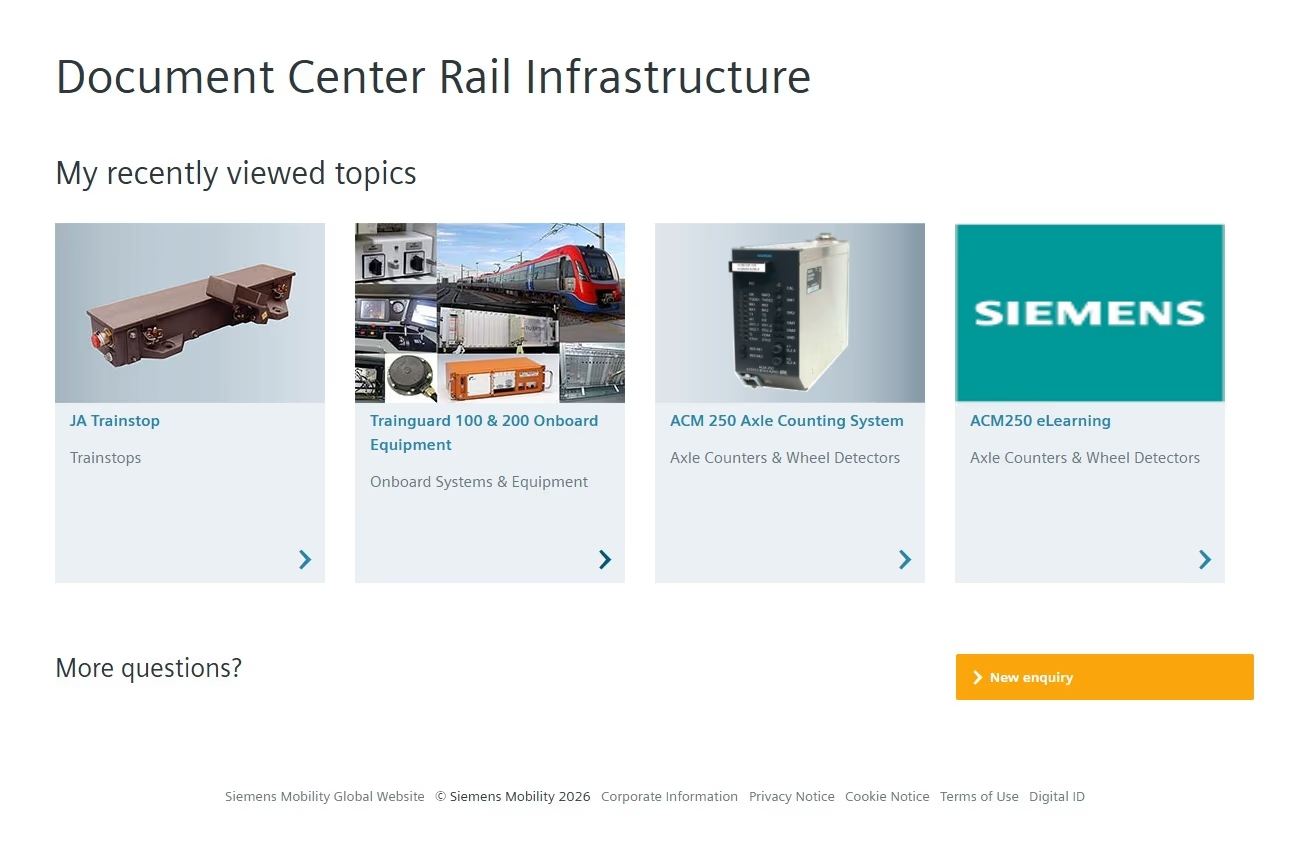
Document Center – Rail Infrastructure
Stay up to date with the latest technical documents and resources for Siemens Mobility Products.

Training Locations
We have training facilities in Perth, Melbourne, Sydney and Brisbane. We also offer training onsite at your premises in Australia and overseas.