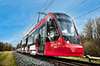
Trams and light rail transits

Siemens has been building electric trams for over 130 years. With our comprehensive expertise, we have repeatedly made crucial advances in this technology. Thanks to our many years’ experience and the knowledge lead we have acquired in recent years, we are a strong partner that you can rely on in every situation. For intra-urban traffic, our product portfolio includes trams and light-rail transit systems.

Avenio – low-floor trams

The Avenio is Siemens' new 100 percent low-floor tram. Experience and innovation combine to produce a vehicle concept that ensures an extremely comfortable ride, minimum wear and environmentally friendly operation. What's more, no other tram has such a high passenger capacity. The Avenio's design makes cities even more attractive while its high energy efficiency makes them even greener. Discover the Avenio for yourself!


ULF – Ultra Low Floor trams

ULF (Ultra Low Floor) is the tram with the lowest entrance height in the world – so low that no platform is needed. This means optimal boarding convenience, which is a particular benefit to the elderly, wheelchair users, and parents with strollers – as is the flat floor throughout the coach. The large number of doors allows fast passenger turnaround – and at travel speeds of up to 70 km/h, it is easily possible to achieve shorter scheduling intervals. The radially-adjustable individual wheel bogies ensure optimum running characteristics.

In order to modernize the tram fleet in Vienna, the local operator Wiener Linien purchased 150 ULF trams in the 1990s. Thanks to the success of their operation and the high degree of acceptance by passengers, another 150 ULFs were ordered in 2004. Continuous production of ULFs allows you to purchase even short production runs at low cost.

Combino – intra-urban service

The Combino tram, with its 100% low floor throughout, was designed specifically for intra-urban use – with narrow curve  radii, short distances between stops, and rapid passenger turnaround. The Combino offers railway operators a broad selection of coach combination options for heavy-traffic lines or less busy routes.

S70 – light rail transit

The S70 vehicle family was developed for the American market – and is a concept for two applications. It can be used either exclusively as light rail transit for fast, comfortable inner city service – or as a regional railway, linking city and region without the need to change trains.

Both solutions are based on the same sophisticated platform concept, which allows maximum design flexibility. The S70 is of low-floor construction, ensuring a high degree of passenger comfort and optimal passenger flow. Its comfort and high travel speed make it an attractive alternative to the auto-mobile in central Europe, as is also the case in the U.S. The S70 likewise meets the notably higher safety standards imposed on mixed traffic on full railway lines. Types SD160 and SD 460 operate as high-floor light rail transit.


VAL – driverless light rail system

The VAL (Véhicule Automatique Léger) is a fully automated driverless light rail that is monitored from an operations control center. Since its introduction in 1983, the VAL system has been continuously upgraded and perfected, with regular improvements in both comfort and safety.

The system features short train interval times (less than a minute), speeds of up to 80 kilometers per hour, and fast acceleration with short braking phases. Flexible division of the cars’ interior expands the available space and therby offers increased passenger capacity. This can be readily adapted to individual customer requirements, enabling the system to be flexibly deployed throughout the world.


Service

Whether in Melbourne or Sacramento, an efficient railway operation requires effective service concepts. We’re at home anywhere in the world, and can offer maintenance solutions matched perfectly to our customers’ present and future requirements.

Our comprehensive range of services offers flexible solutions for professional maintenance, spare parts supply, modernization, accident repair – also for the testing and validation of railway systems.