European Train Control System (ETCS) trackside and on-board
One standard for safer and smarter rail across Europe.
ETCS is operational today on high-speed corridors, regional lines, and urban networks across Europe and beyond. The standard is set. The question for infrastructure managers and fleet operators is no longer whether to deploy ETCS, but how to get the architecture, migration path, and timeline right.
Siemens Mobility has been shaping that answer since the standard's earliest days. Our trackside and onboard systems run in nationwide programs like Finland's 6,000 kilometers Digirail rollout. Thameslink in London operates the world's first commercial ATO (Automatic Train Operation) over ETCS in daily passenger service. We deliver large-scale fleet retrofits for operators like Belgium's SNCB and network modernizations for Switzerland's BLS. And we will upgrade the entire Norwegian railway network of approximately 4,200 track kilometers to ETCS Level 2. These projects represent a selection from a much broader portfolio of ETCS deployments across all levels, scales, and geographies. Whether you are selecting an ETCS level for a corridor, planning a nationwide migration, or coordinating a fleet retrofit, the following sections provide the technical foundation and strategic insights you need to execute your deployment with confidence.
What is ETCS?
European Train Control System or ETCS is the standardized digital train control and protection system defined under the EU's CCS TSI (Control Command and Signalling (CCS), Technical Specifications for Interoperability (TSI)). It replaces more than 20 incompatible national signaling systems with one interoperable standard, managing movement authority, speed supervision, and train separation across European rail networks.
Within the European Rail Traffic Management System (ERTMS) framework, ETCS defines how trains receive and enforce movement authorities, how safe separation is maintained, and how onboard systems interact with trackside infrastructure. The current deployment standard is Baseline 4 (B4R1), though Baseline 3 and Baseline 2 remain operational on significant parts of the European network. ETCS operates across three interdependent technical layers: trackside signaling, onboard computing, and radio communication. Getting the interplay between these layers right, across baselines, national borders, and legacy system boundaries, is the central systems integration challenge in any ETCS deployment.
The scale of ETCS deployment and the decisions it demands
The EU has mandated ETCS on the Trans-European Transport Network (TEN-T) core network by 2030. The scope encompasses thousands of kilometers of track and tens of thousands of vehicles. Most national rollout programs are now past the planning phase and moving into procurement or early deployment. Switzerland, Luxembourg, and Belgium have already completed their ETCS rollout.
The architecture decisions being made today will determine operational performance and total cost of ownership for the next 30 years.
Every ETCS program requires coordinated decisions across two domains: the network infrastructure and the fleet that operates on it.
Infrastructure decisions
- Which ETCS level and operating mode match the network profile?
The choice between Level 1 and Level 2, and within Level 2 between fixed block, Hybrid Train Detection (HDT), and Moving Block, determines both capacity potential and infrastructure investment. - Centralized or distributed: which signaling architecture fits the operational requirements?
This decision affects availability, scalability, lifecycle cost, and future upgradeability.
- How to phase trackside migration without disrupting operations?
Corridor sequencing and coordination with fleet readiness are critical success factors.
- How to make the infrastructure ATO-ready from day one?
ETCS Level 2 is the safety foundation for ATO. Planning for it now avoids costly retrofits later.

Fleet decisions
- How to retrofit existing rolling stock cost-effectively, and when?
Timing the retrofit to align with infrastructure deployment avoids both dual-equipment phases and bottlenecks.
- Which On-Board Unit (OBU) configuration ensures interoperability across borders, baselines, and radio generations?
For OBUs, multi-baseline, multi-NTC, and dual-radio capability are becoming standard requirement.
- Are vehicles prepared for ATO?
Equipping rolling stock with ATO-ready on-board units during the ETCS retrofit avoids a second intervention cycle.
Understanding ETCS levels
Level 1 and Level 2 Modes HTD and Moving Block
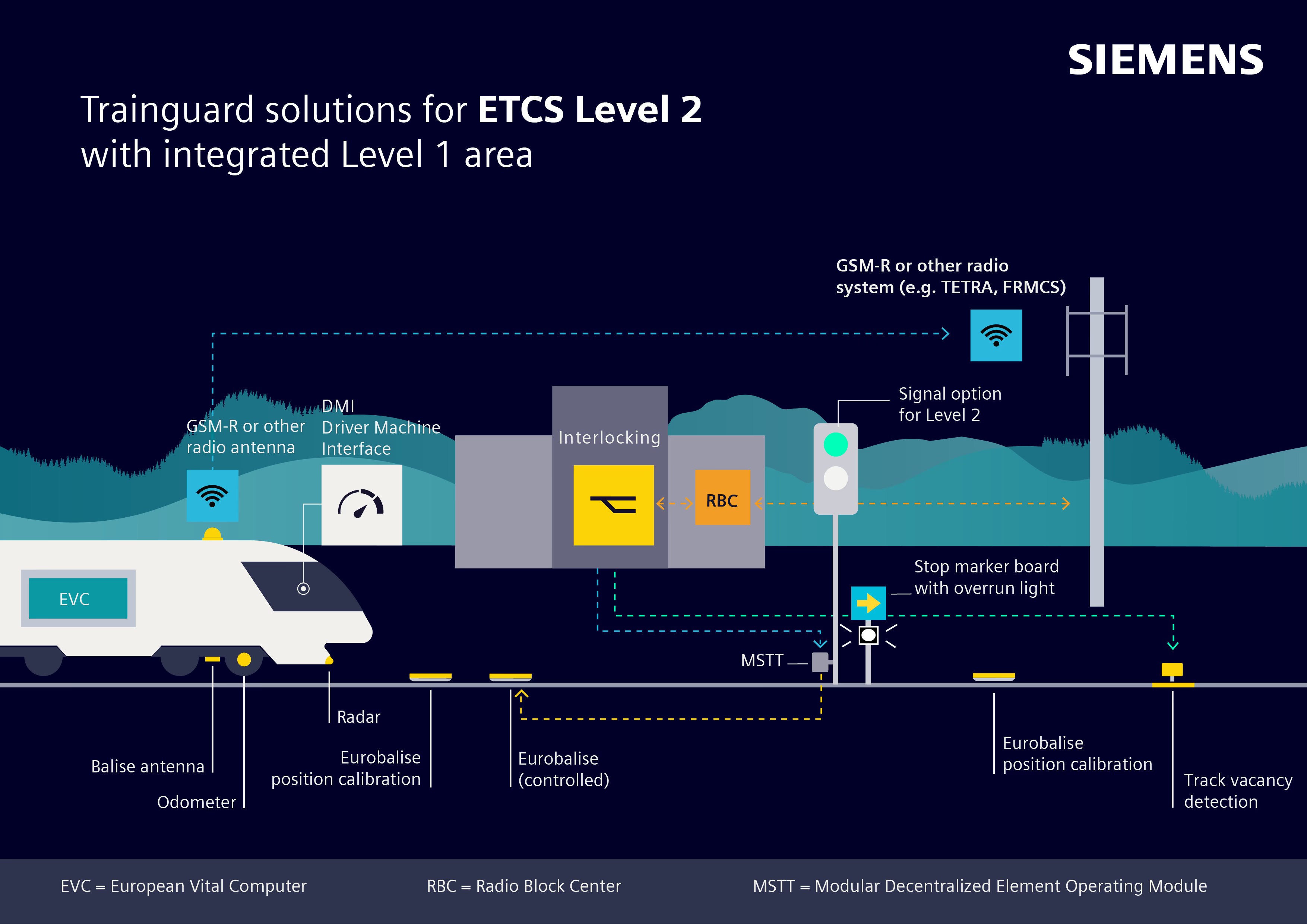
Level 1 keeps lineside signals in place and adds ETCS as a protective overlay. Trains read Eurobalises for location and speed data; the onboard unit supervises braking if limits are exceeded. Level 1 delivers safety and interoperability without replacing trackside infrastructure, making it the fastest path to compliance on secondary lines and cross-border freight routes.
Level 2 removes lineside signals entirely. Movement authority comes from the Radio Block Centre (RBC) via continuous radio communication. Trains report their position and the RBC calculates and transmits updated movement authorities in real time. Level 2 is the dominant deployment standard across Europe today, underpinned by Global System for Mobile Communications - Railway (GSM-R), with Future Railway Mobile Communication System (FRMCS) emerging as its successor.
Level 2 supports two advanced train separation modes that increase capacity beyond conventional fixed-block operation:
Both modes depend on TIMS, which continuously verifies that all vehicle units remain coupled and reports the confirmed train length to the RBC via the European Vital Computer (EVC). Without TIMS, the RBC cannot determine where a train ends and must rely on conventional trackside detection.
ETCS trackside: Signaling infrastructure for interoperable corridors
Trackside infrastructure forms the fixed backbone of ETCS Level 2 deployment: electronic interlockings, Radio Block Centres, Eurobalises, lineside electronic units (LEUs), and field elements. The most consequential architecture decision is whether to deploy RBCs and interlockings in a distributed model, with local installations along the line, or to centralize them in signaling data centers serving entire regions or countries.
- Germany's Warnemünde project put the first digital interlocking into mainline service, demonstrating IP-based, centralized signaling with standardized interfaces in live operations.
- Finland's Digirail program scales this approach to nationwide scope DS3 data centers host centralized interlockings and RBCs with geo-redundant configurations, operated through Siemens Mobility's Signaling X platform.
For infrastructure managers weighing long-term cost against operational resilience, these two references mark the range of what centralized architectures deliver in practice today.

ETCS onboard: Equipping vehicles for cross-border operations
Cross-border interoperability places the highest demands on onboard equipment. A train traveling from Germany through France into Spain may encounter different ETCS baselines (Baseline 2 remains widespread; Baseline 3 is the current standard), different ETCS levels, and different legacy national systems on a single journey. The OBU must handle all of these without hardware changes.
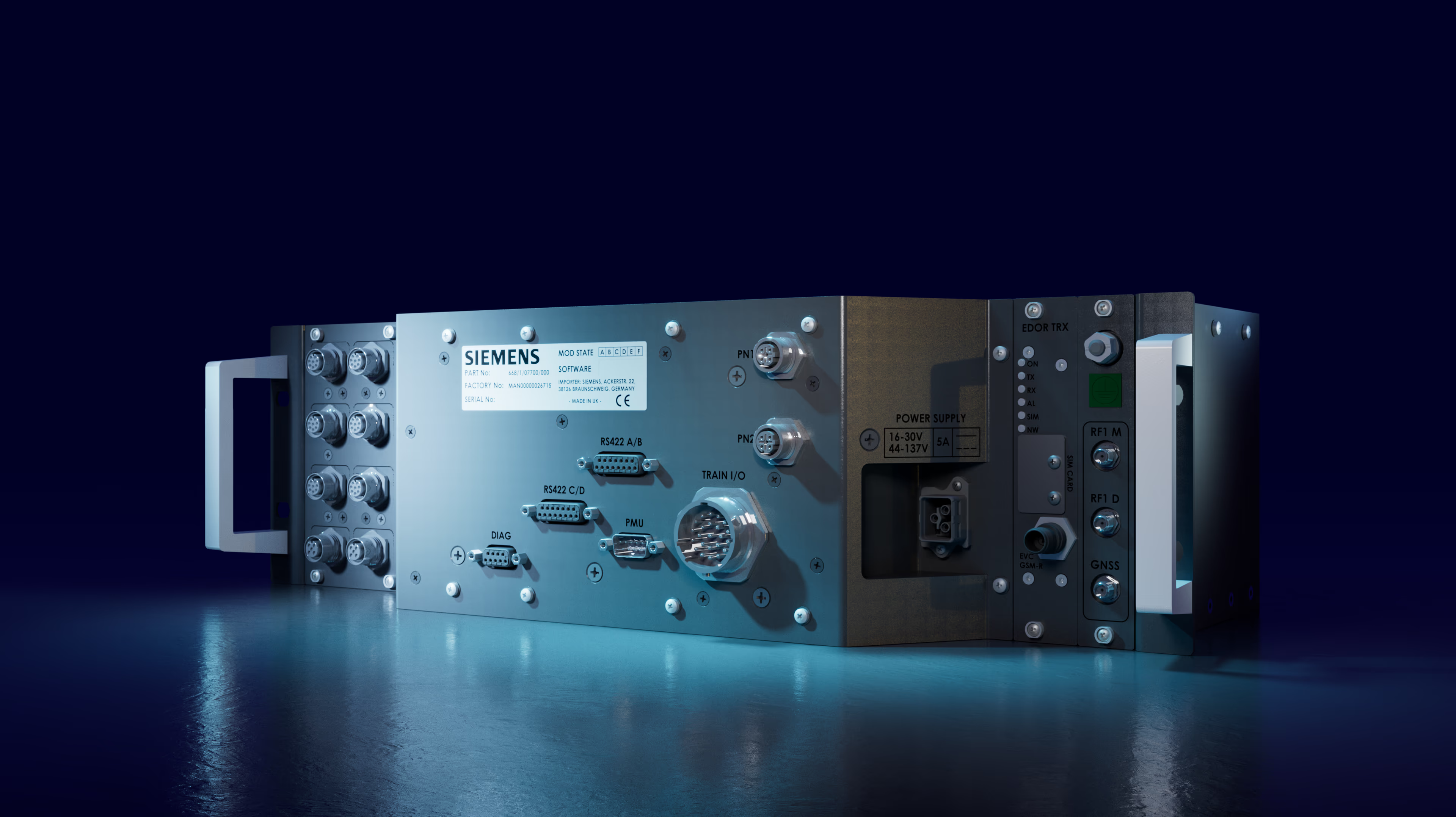
Retrofitting existing fleets with ETCS onboard technology requires precise coordination of installation windows during planned maintenance, certification and testing cycles, and alignment with infrastructure deployment timelines on each corridor. Trainguard 100/200 OBU, proven over millions of operational kilometers, supports ETCS Baseline 4 with backward compatibility to Baseline 2 and Baseline 3, multi-radio capability (GSM-R and TETRA, including FRMCS-readiness), and multi-NTC configurations. Fleet operators use these multi-baseline OBUs to standardize across vehicle types, reducing certification complexity without sacrificing route flexibility.

ETCS communication: From GSM-R to FRMCS
ETCS Level 2 depends on continuous radio contact between trains and RBCs. GSM-R has served as the communication backbone for over two decades, but the technology is approaching end-of-life. Its successor, FRMCS is based on 5G and entering deployment across Europe.
The transition creates a dual-mode coordination challenge. Infrastructure managers must plan radio coverage and network migration timelines. Fleet operators must equip OBUs with dual-radio capability. A mismatch between infrastructure readiness and fleet readiness can ground trains or leave infrastructure underutilized. Finland's Digirail program demonstrates an alternative: using commercial mobile networks for ETCS Level 2 communication, among the first in Europe, reducing dependency on dedicated rail spectrum. Siemens Mobility's dual-radio OBUs allow fleet operators to manage the GSM-R-to-FRMCS transition without full fleet replacement.
ATO over ETCS: automation built on a safety foundation
Automatic Train Operation (ATO) over ETCS uses the train control system as the underlying safety layer while ATO optimizes driving profiles for:
- capacity gains of up to 30%
- punctuality improvements of up to 15%
- energy savings of up to 30%
ETCS supervises safe movement; ATO determines how the train moves within those safety limits. The system connects ATO onboard and trackside functions with traffic management - in Siemens Mobility's architecture through Controlguide operations control system (OCS) - and real-time dispatching to coordinate train operations across the network.
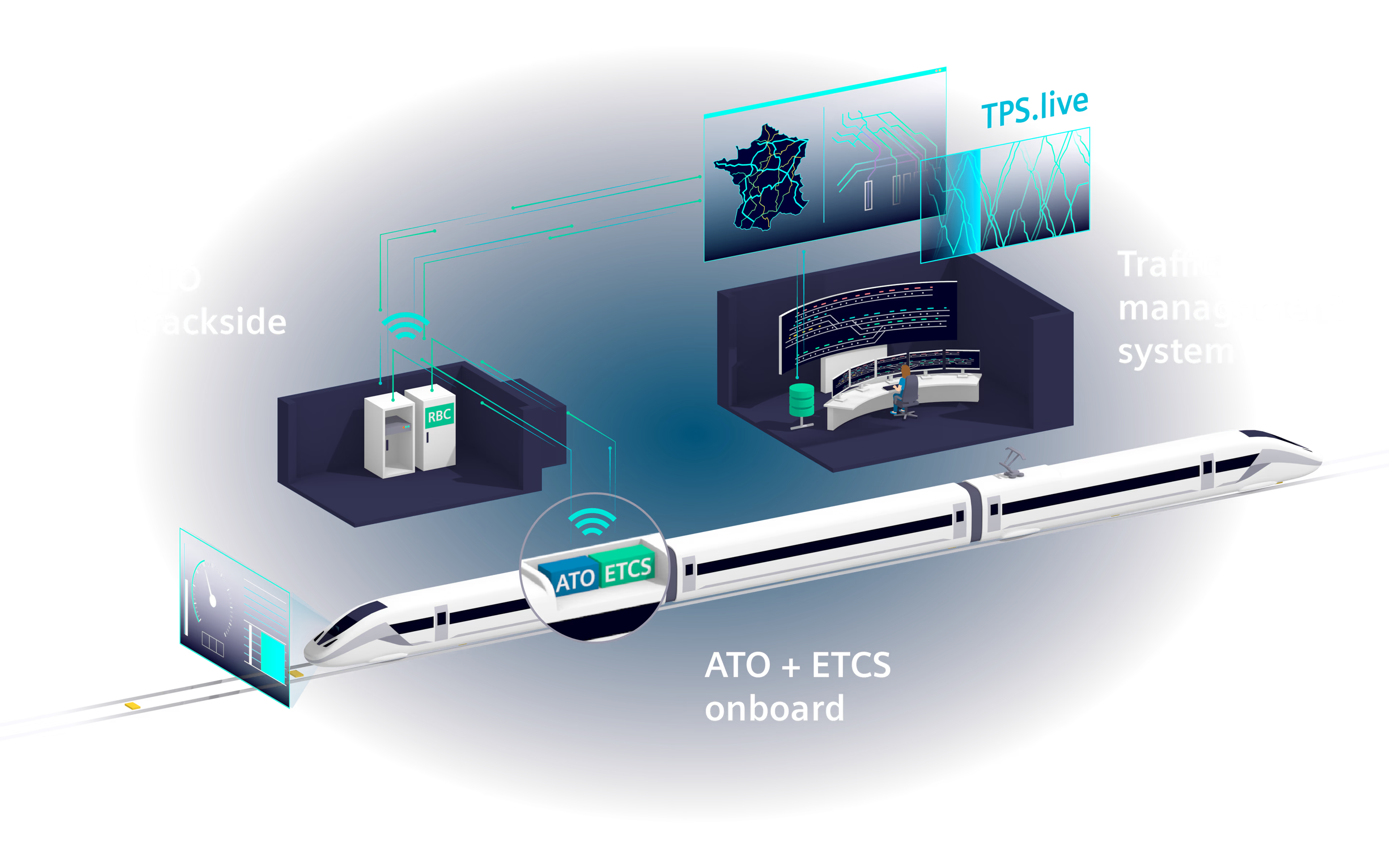
Hamburg's Digitale S-Bahn proves what this means in daily operations. Four S-Bahn trains operate at ATO Grade of Automation 2 on a section of the Hamburg S-Bahn network, carrying passengers in regular service with automated driving, supervised by the driver. The project, developed together with Deutsche Bahn and the city of Hamburg, marked one of the first digital automated train operations based on ETCS that went into regular passenger service on a suburban rail network. For operators looking to increase frequency and reduce energy consumption on high-demand urban corridors without building new infrastructure, the Hamburg model delivers operational proof. ATO use case: network capacity for urban transport
ETCS projects and references: deployed, operational, proven
These programs span countries, ETCS levels, and project types, from nationwide greenfield rollouts to complex brownfield retrofits. Each confirmed that successful ETCS deployment is an organizational and systems integration challenge as much as a technology project, requiring close coordination between fleet, infrastructure, and operations teams.
Beyond ETCS deployment: operating a connected railway safely
ETCS deployment is a starting point. As rail networks become more connected and software-defined, two operational dimensions become increasingly critical:

Workforce qualification
ETCS changes how trains are driven, how infrastructure is maintained, and how incidents are investigated. Ensuring that drivers, maintainers, and control room staff are fully prepared is a safety-critical requirement that deserves the same rigor as the technology itself. Siemens Mobility's qualification services cover on-site and virtual training programs as well as certified test and validation at accredited facilities, including the Wegberg-Wildenrath test center.

Cybersecurity
A connected railway is an exposed railway. ETCS infrastructure, from onboard units to RBCs to communication networks, represents an expanded attack surface that must be actively protected. Cybersecurity is not an afterthought: it is a core system requirement, embedded from design through operations. Siemens Mobility addresses this with a holistic cybersecurity approach spanning dedicated rail cybersecurity services for regulatory compliance and operational security, and CoreShield infrastructure protection for transport systems.