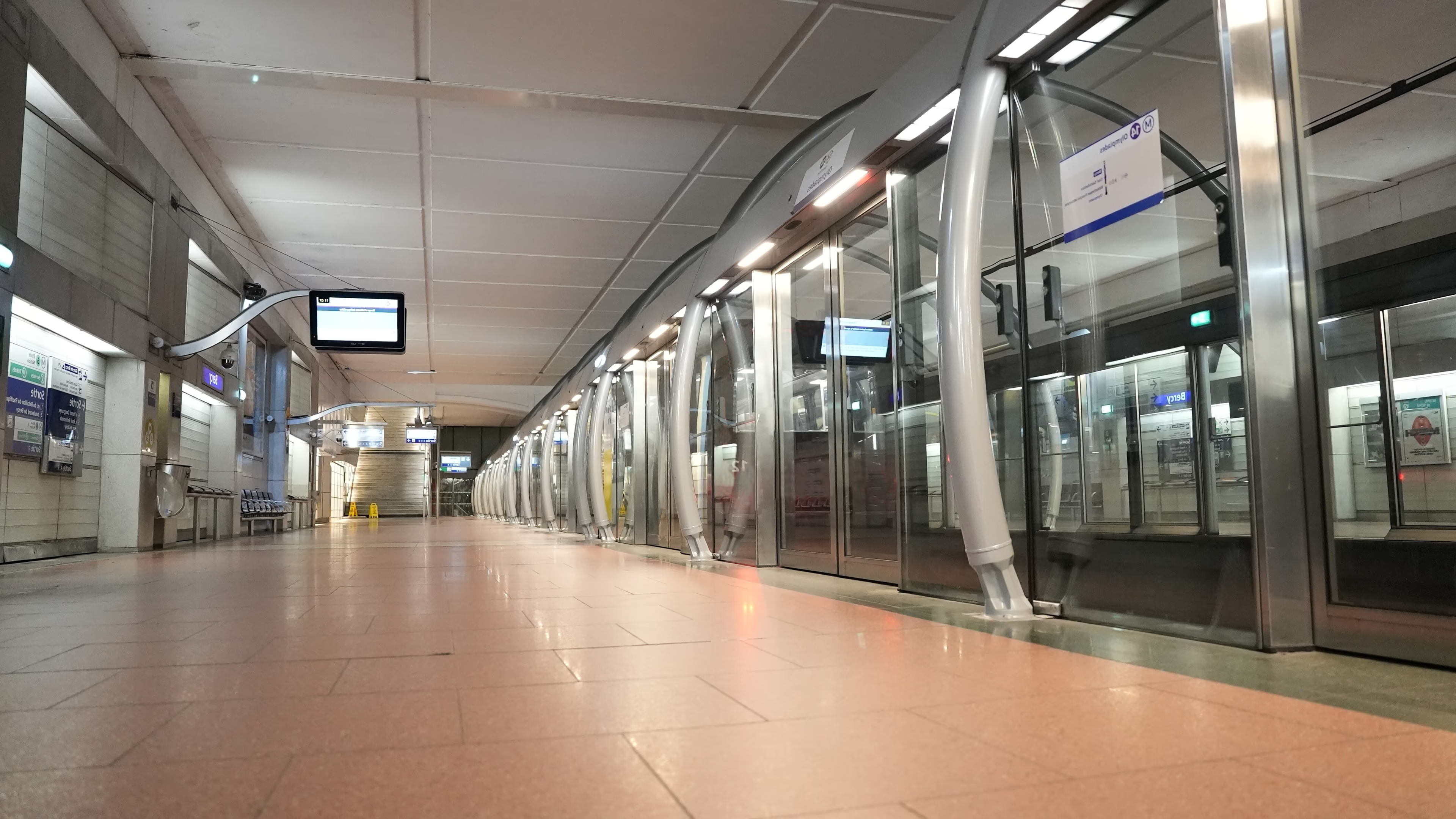
Metro line 14 in Paris: modernized, improved, extended
In the heart of Île-de-France, we embarked on an important mission to transform mobility for everyone in Paris. Our goal was to modernize metro Line 14 by transitioning the already automated and driverless line to an even more advanced Communications-Based Train Control System (CBTC). This significant project aimed to enhance efficiency, reliability and increase capacity of the rail network.
Enhancing daily commute
Nearly 30 years ago, in 1998, Line 14 began its fully automated journey, providing a critical link for Parisians traveling through the city. This was the starting point for our long-standing collaboration with our trusted partner RATP, with our dedicated teams in Châtillon working side by side.
The latest milestone, a contract awarded in 2018, included two major projects:
- Renewal of the automation system on existing line 14: we replaced the old automation system with the advanced Trainguard MT CBTC system, enhancing performance, reliability, and availability.
- Extension of automation north and south: we doubled the line's length, installing the new system on 72 MP14 trains, making Line 14 the longest in the Paris network.
In a bustling metropolis like Paris, where millions rely on the metro for their daily commute, Line 14 was ready for an upgrade. Our mission was to elevate this pioneering line to new heights of efficiency and reliability, ensuring it meets the needs of modern travelers and continues to be a vital part of Paris’s public transportation network.
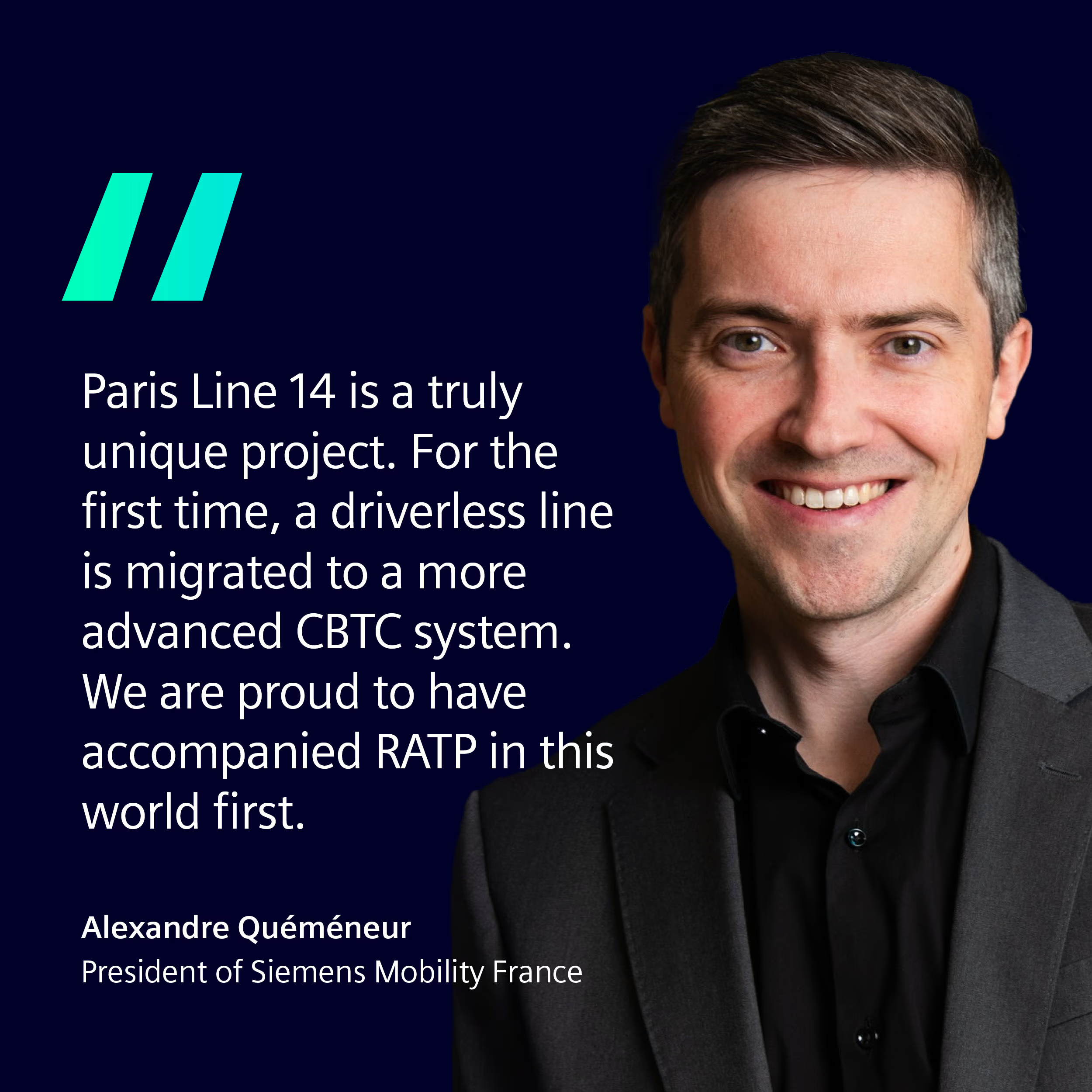
It is the first time that a fully automated driverless metro line (GoA – Grade of Automation) has been migrated to a more advanced CBTC GoA system. The new system ensures even more efficient and reliable service on the line, which has doubled in length due to extensions to the north and south, now spanning 28 kilometers. This expansion has made Line 14 the longest metro line in Paris.
Thanks to our market-leading signaling system, the trains on Line 14 operate with remarkable precision, running just 85 seconds apart. This exceptional efficiency makes Line 14 one of the most reliable and high-performing lines in the Paris metro network, transporting 40,000 passengers per hour and per direction and up to one million users daily.
Ensuring seamless journeys
Travelers arriving at Orly Airport, eager to reach the vibrant heart of Paris, can now do so in just 20 minutes. Meanwhile, those traveling from the bustling business districts in Saint-Denis Pleyel can reach Orly Airport in just 40 minutes. With its improved capacity, reliability, and efficiency, Line 14 serves as the backbone of Paris' public transportation system, connecting to the future lines 15, 16, 17 and 18 of the Grand Paris Express network.
We deliver expertise as a reliable partner for operators:
"For the past 30 years, we've been supporting RATP to consistently modernize its network, meeting the growing mobility needs of millions of users in greater Paris. We have carried out automation projects of unparalleled complexity and technical sophistication that put Paris at the forefront of driverless technology globally", says Alexandre Quéméneur, CEO of Siemens Mobility France.
Overcoming complex challenges
The extension and modernization of line 14 is a truly unique project. It is the first time in the world that an automated driverless (GoA4) metro line in operation is migrated to a new, more advanced CBTC system.
Combining the real and the digital worlds
Our work on Line 14 is also a testament to our contribution to the French economy. Over six years, more than 250 of our engineers dedicated 500,000 hours to this project. More than 80 percent of the automation equipment was manufactured and integrated in France, supporting local industries and partners.
“Supporting French industry while improving the passenger experience and the sustainable benefit of public transport means our Siemens Mobility teams have every reason to be proud of the completion of this project to modernize line 14!” says Alexandre Quéméneur, CEO of Siemens Mobility France.
Line 14: 30 years of innovation
- October 15, 1998: Inauguration of the first route of Line 14 equipped with our signaling solution, initially named Meteor (METro-Est-Ouest-Rapide), This line connected seven stations between Madeleine and Bibliothèque François Mitterrand in record time. It was the first metro line built in the capital in half a century and the first fully automated driverless line in Paris, thanks to our efforts at Siemens Mobility.
- 2003: Extension north from Madeleine towards Saint-Lazare
- 2007: Extension south of the François Mitterrand Library towards Olympiades
- 2010: Extension north of Saint-Lazare towards Saint-Ouen Town Hall
- 2018: RATP awarded us the modernization of Line 14 in two parts:
- the renewal of its automation system on the existing line between Mairie de Saint-Ouen and Olympiades
- its extensions to the north to Saint-Denis-Pleyel and to the south to Orly airport
- 26 February, 2024: Line 14, equipped with the new Train Operations Automation System (SAET) welcomes its first customers.
- June 2024: Extension to Saint-Denis Pleyel and Orly Airport to facilitate transfers to the airport in the south of Paris. Eventually, the 72 trainsets of 8 cars will be equipped with our "Trainguard MT CBTC" automation system.
The Communications-Based Train Control (CBTC) automation system, a result of advances in software, hardware, and communication development, is based on a principle of train detection and tracking independent of track circuits.
To achieve this, it uses safety computers (balises) fixed on the ground and on board of the trains (on-board units).
One of the features of CBTC is the Grade of Automation (GoA), which varies according to the operator's traffic and operating requirements, ranging from simple ceiling speed control to full line automation without any personnel on board the trains.
On a fully automated line, the spacing between trains is no longer based on fixed blocks determined by the track signals, but on mobile blocks determined by CBTC automation, which reduces the interval between trains to increase transport capacity.
Our signaling solution Trainguard MT CBTC significantly increases the performance and capacity of existing lines without major infrastructure works that would come with building new routes.
For the metro operator, it improves operational efficiency by increasing the availability, reliability, and safety of services. It allows operators to:
- Adapt the service offering in real-time dynamically, by increasing the number of trains in operation and reacting to incidents more quickly than with manual train driving
- Significantly reducing the interval between trains, up to 85 seconds, with an increased frequency of up to 20 seconds
- To increase capacity by 20 %
- Reduce energy consumption by 15 % thanks to a traction energy recovery system.
For passengers, it means better service quality with more frequent and punctual trains, reduced downtime in stations, and a faster recovery of services in the event of disruptions.